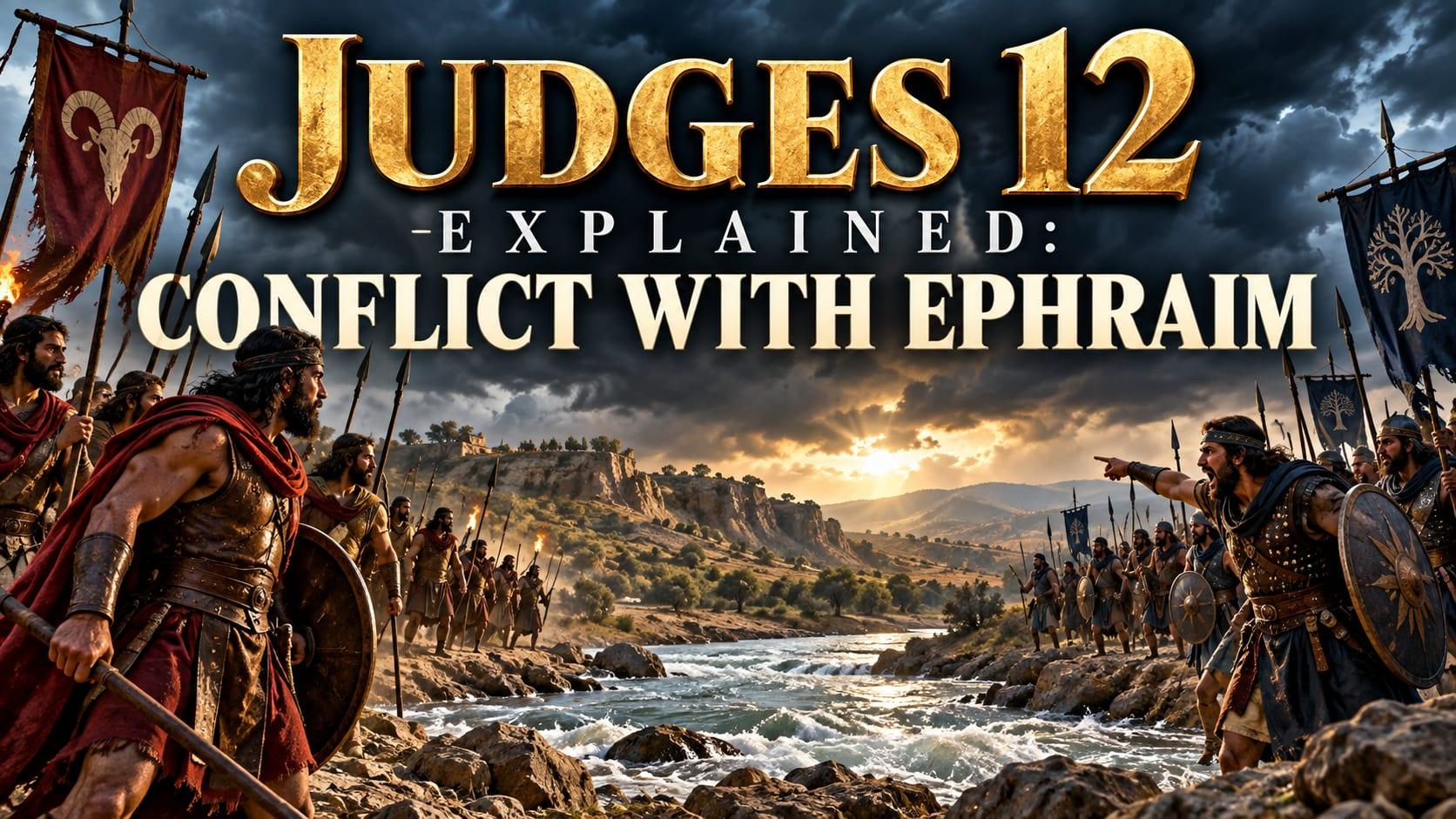
📖 Judges 12 Explained: Shibboleth and Three Quiet Judges
One word decided who lived and who did not. Not a weapon. A single sound a man either could say or could not.
Judges 12 explained is fifteen verses that split cleanly into two very different stories. The first six verses record a civil war inside Israel itself, started by the same complaint that almost started one two chapters earlier, and ended with a test of pronunciation that gave the English language a word still used today. The last nine verses slow all the way down and bury three judges, Ibzan, Elon, and Abdon, one after another, in almost no space at all.
Maybe you have watched two people make the exact same accusation against two different leaders, and seen it land completely differently depending on who answered it.
- ❓ Why did Ephraim pick a fight with Jephthah over the exact same thing they already brought to Gideon?
- ❓ What does the word "shibboleth" actually mean, and why did it become the test?
- ❓ Why does the text not even name the city where Jephthah was buried?
- ❓ Why does Scripture bother recording three judges it barely says anything about?
📌 Judges 12 puts a bloody answer to a complaint right beside three quiet, unremarkable lives, and the contrast is the whole point.
This walkthrough goes through the whole chapter in order: Ephraim's accusation, the war inside Gilead that follows it, the test at the fords of Jordan, Jephthah's own death, and the three judges who lead Israel for twenty five combined years without a single battle recorded between them.
Fifteen verses, one costly accent, and three men the Bible barely slows down for.
What Happened Just Before This Chapter
Judges 11 ended with Jephthah home from a decisive victory over Ammon, his daughter dead or dedicated depending on how the vow is read, and Israel's daughters keeping a yearly memorial for her. The war with Ammon is over. Jephthah has just become the man Gilead needed.
Judges 12 opens with a different threat, and this one comes from inside Israel's own borders.

Judges 12 Explained Verse by Verse
1. Ephraim's Complaint, Again (verses 1 to 3)
The men of Ephraim show up angry, and their opening line should sound familiar.
"And the men of Ephraim gathered themselves together, and went northward, and said unto Jephthah, Wherefore passedst thou over to fight against the children of Ammon, and didst not call us to go with thee? we will burn thine house upon thee with fire."
📌 Ephraim brought this exact complaint to Gideon in Judges 8, word for word in substance: why were we not called to fight? Gideon answered with flattery, telling Ephraim their leftover gleanings mattered more than his own army's whole harvest, and his anger was turned away. Jephthah does not reach for flattery. He reaches for the facts.
"And Jephthah said unto them, I and my people were at great strife with the children of Ammon; and when I called you, ye delivered me not out of their hands."
"And when I saw that ye delivered me not, I put my life in my hands, and passed over against the children of Ammon, and the LORD delivered them into my hand: wherefore then are ye come up unto me this day, to fight against me?"
💡 Jephthah says he did call Ephraim, and they did not come. That detail is not recorded back in Judges 11, which only shows him gathering Gilead and Manasseh before the Spirit of the LORD came upon him. Whether or not Ephraim ever actually got the call, Jephthah's answer is a plain restating of what happened, not an apology and not praise for the men threatening to burn his house down. Proverbs 15:1 says a soft answer turns away wrath. Jephthah gives Ephraim a true answer instead of a soft one, and it does not turn their wrath away at all.
2. Gilead Fights Ephraim (verse 4)
Words stop. The chapter moves straight to battle, and this time the enemy is family.
"Then Jephthah gathered together all the men of Gilead, and fought with Ephraim: and the men of Gilead smote Ephraim, because they said, Ye Gileadites are fugitives of Ephraim among the Ephraimites, and among the Manassites."
⚠️ Notice the insult that tips this into outright war: Ephraim calls Gilead's men fugitives, runaways who do not really belong among Ephraim and Manasseh. Gilead sat east of the Jordan, inside Manasseh's larger territory, and Ephraim's jab questions whether the men on that side of the river even count. Jephthah, who spent his own youth being told by his brothers that he did not belong in his father's house, is now the one leading a people being told the exact same thing on a national scale.
3. The Shibboleth Test at the Fords of Jordan (verses 5 and 6)
Gilead wins the battle, then controls the river crossing Ephraim's survivors need to get home.
"And the Gileadites took the passages of Jordan before the Ephraimites: and it was so, that when those Ephraimites which were escaped said, Let me go over; that the men of Gilead said unto him, Art thou an Ephraimite? If he said, Nay;"
💡 An Ephraimite trying to slip past the checkpoint would naturally say no, he is not one of them. So the Gileadites needed a way to catch a lie a man could tell with his words but not with his mouth.
"Then said they unto him, Say now Shibboleth: and he said Sibboleth: for he could not frame to pronounce it right. Then they took him, and slew him at the passages of Jordan: and there fell at that time of the Ephraimites forty and two thousand."
📌 Shibboleth is a Hebrew word, usually carrying the sense of an ear of grain or a flowing stream. The actual meaning barely matters here. What matters is the sh sound at the front of it, a sound the Ephraimite dialect apparently could not produce, coming out instead as an s. Gilead's men did not need weapons or witnesses at the crossing. An accent was evidence enough.
⚠️ Forty two thousand is the number the text gives for Ephraimites who fell in this conflict with Gilead. This is the word that gave English the term "shibboleth," still used for any word or custom that instantly marks who is an insider and who is not.

4. Jephthah's Death and an Unnamed Grave (verse 7)
One verse closes out the man who filled the last two chapters.
"And Jephthah judged Israel six years. Then died Jephthah the Gileadite, and was buried in one of the cities of Gilead."
📌 "One of the cities of Gilead" is vague in a way the next three burial notices in this same chapter are not. Ibzan is buried at Bethlehem, Elon at Aijalon, Abdon at Pirathon, each one named plainly. Jephthah, the outcast who fought his way into leadership and then into the family history that once rejected him, does not even get a named resting place in the text. Six years is also a short judgeship next to what came before it, two chapters of detail for a six year rule.
5. Three Judges in Nine Verses: Ibzan, Elon, and Abdon (verses 8 to 15)
The chapter's pace changes completely. No war, no vow, no crisis. Just three men, their years, and where they were laid to rest.
"And after him Ibzan of Bethlehem judged Israel. And he had thirty sons, and thirty daughters, whom he sent abroad, and took in thirty daughters from abroad for his sons. And he judged Israel seven years."
💡 Sixty children between sons and daughters, and thirty marriages arranged outward and thirty arranged inward, all in two verses. Many Bible teachers place this Bethlehem in Zebulun's territory, listed among Zebulun's cities in Joshua 19, rather than the Bethlehem south of Jerusalem where David and later Jesus were born, though the text here does not say which one directly. Like Tola and Jair in Judges 10, the text measures Ibzan by family and years, not by any battle he fought.
"And after him Elon, a Zebulonite, judged Israel; and he judged Israel ten years. And Elon the Zebulonite died, and was buried in Aijalon in the country of Zebulun."
💡 Elon gets ten years and two short sentences. Joshua 19 lists Zebulun's inheritance among the tribal territories, the same region Elon leads from and is buried in. A full decade of leadership, and the entire record of it fits in a single verse plus his burial notice.
"And after him Abdon the son of Hillel, a Pirathonite, judged Israel. And he had forty sons and thirty nephews, that rode on threescore and ten ass colts: and he judged Israel eight years."
📌 Forty sons, thirty nephews, and seventy donkey colts for them to ride describes real wealth and standing, the same kind of picture Scripture paints of other prominent men without ever calling it sin. Riding on donkeys rather than horses was itself a mark of a settled, peaceful household, not a military one.
"And Abdon the son of Hillel the Pirathonite died, and was buried in Pirathon in the land of Ephraim, in the mount of the Amalekites."
💡 Pirathon sat inside Ephraim's own hill country, the same tribe that just lost forty two thousand men earlier in this chapter, now quietly producing the next judge only a handful of verses later. "The mount of the Amalekites" most likely points back to the same Ephraimite hill country Deborah's song in Judges 5 describes, where it says out of Ephraim there was a root of them against Amalek. A place once associated with old conflict against Amalek becomes, generations later, simply where a judge's family was buried.

Hard Questions Judges 12 Raises
Why did the same complaint end peacefully with Gideon and in civil war with Jephthah? What the text says: Ephraim brought nearly the same words to both judges, asking why they were not called to fight. How this is read: Gideon answered by praising Ephraim above his own men, and Judges 8 says his answer turned their anger away. Jephthah answered with facts, including the accusation that Ephraim failed to come when actually called, and the result was war rather than a cooled temper. The text does not say Jephthah was wrong to answer honestly. It simply shows two different leaders and two very different outcomes from the same provocation.
Is forty two thousand meant as an exact count? What the text says: verse 6 states the number plainly, as the Ephraimite death toll from this whole conflict with Gilead. How this is read: large numbers in the Old Testament are sometimes debated among scholars over whether a Hebrew term is functioning as a literal count or as a measure of a military unit, but Judges 12:6 gives no indication the word is being used any way other than as a straightforward number. The text presents it as a staggering, real cost of the war, not a figure of speech.
Why does the Bible bother recording three judges it says almost nothing about? What the text says: Ibzan, Elon, and Abdon together rule twenty five years, and verses 8 to 15 give them eight verses combined, mostly listing children, years, and burial places. How this is read: these minor judges are not written as failures or omissions. Their short entries stand right next to Jephthah's two dramatic chapters as proof that most of Israel's leadership during this period was quiet and stable, not constant crisis. Scripture records the stretch of ordinary years alongside the extraordinary ones.
Does the unnamed burial place in verse 7 suggest something negative about Jephthah? What the text says: it states only that he was buried in one of the cities of Gilead, without naming which one, unlike the specific cities given for Ibzan, Elon, and Abdon right after him. How this is read: the text offers no judgment attached to the vagueness, and Hebrews 11 later lists Jephthah among those commended for their faith. The missing detail is worth noticing as a contrast in how the chapter records its four judges, not as evidence of Scripture condemning him.
Top Verses From Judges 12
1. Judges 12:3
"And when I saw that ye delivered me not, I put my life in my hands, and passed over against the children of Ammon, and the LORD delivered them into my hand: wherefore then are ye come up unto me this day, to fight against me?"
Jephthah answers an accusation with the plain record of what actually happened, instead of the flattery that worked for Gideon in the chapter before this one.
2. Judges 12:6
"Then said they unto him, Say now Shibboleth: and he said Sibboleth: for he could not frame to pronounce it right. Then they took him, and slew him at the passages of Jordan: and there fell at that time of the Ephraimites forty and two thousand."
A single word, spoken wrong by accident of dialect, decided who crossed the river alive. The verse that put a new word into English.

3. Judges 12:7
"And Jephthah judged Israel six years. Then died Jephthah the Gileadite, and was buried in one of the cities of Gilead."
The man two chapters were built around gets a single sentence and a grave the text does not even bother to name.
4. Judges 12:9
"And he had thirty sons, and thirty daughters, whom he sent abroad, and took in thirty daughters from abroad for his sons. And he judged Israel seven years."
Ibzan's entire seven year judgeship, reduced to his family and his years, proof the text can measure a leader by stability instead of battles won.
5. Judges 12:15
"And Abdon the son of Hillel the Pirathonite died, and was buried in Pirathon in the land of Ephraim, in the mount of the Amalekites."
The very tribe that lost forty two thousand men earlier in this chapter quietly closes it out by burying Israel's judge in its own hill country.
Frequently Asked Questions About Judges 12
What happened in Judges 12?
Ephraim threatened to burn Jephthah's house down for not calling them to fight Ammon. Jephthah answered that he had called them and they refused to come, and the dispute turned into a civil war between Gilead and Ephraim. Gilead won, then used the word shibboleth at the fords of Jordan to catch fleeing Ephraimites by their accent, killing forty two thousand. Jephthah judged six more years, died, and was followed by three minor judges, Ibzan, Elon, and Abdon, who together led Israel for twenty five quiet years.
What does shibboleth mean in the Bible?
Shibboleth is a Hebrew word usually meaning an ear of grain or a flowing stream. In Judges 12 its meaning matters far less than its sound, since Ephraimites could not pronounce the sh at the start of it and said sibboleth instead, which is how Gilead's men identified them at the river crossing.
Why did Ephraim fight with Jephthah?
Ephraim was angry that Jephthah fought Ammon without calling them to join, the same complaint they had already brought to Gideon. Jephthah answered that he had called them and they did not come to help, and that response, true or not, did not calm Ephraim the way Gideon's flattery once had.
Why is the shibboleth test so famous?
It is the clearest example in the Bible of a dialect difference used as a life or death identity check. The word "shibboleth" passed into English from this exact passage, now used for any word, phrase, or custom that instantly reveals whether someone belongs to a group.
How many Ephraimites died in Judges 12?
Verse 6 states that forty two thousand Ephraimites fell in the conflict with Gilead, counted at the fords of Jordan during the shibboleth test.
Where was Jephthah buried?
Verse 7 only says he was buried in one of the cities of Gilead, without naming which city. That is notably vague compared to the named burial cities given for the three judges who follow him in the very same chapter.
Who were Ibzan, Elon, and Abdon?
They were three minor judges who led Israel after Jephthah. Ibzan of Bethlehem judged seven years and had thirty sons and thirty daughters. Elon the Zebulonite judged ten years. Abdon of Pirathon judged eight years and had forty sons and thirty nephews. None of them are shown leading Israel into battle.
Why does the Bible include judges who did almost nothing notable?
Their brief entries show that Israel's history during this period included long stretches of ordinary, stable leadership, not only the dramatic crises the longer chapters record. A short record is still a true record of real years under real leaders.
Is this the same Bethlehem where Jesus was born?
No. Ibzan's Bethlehem in verse 8 is generally identified with the Bethlehem in Zebulun's territory, a different town from the Bethlehem in Judah south of Jerusalem where David and later Jesus were born.
Final Thoughts
Judges 12 holds two completely different kinds of history side by side, and both are worth taking seriously.
📌 The same complaint can land as a crisis or pass without a fight, depending entirely on how it is answered. Gideon's flattery and Jephthah's facts met the identical accusation and produced opposite results.
📌 A small difference can carry enormous weight. One mispronounced consonant at the fords of Jordan decided who lived, a sobering picture of how easily belonging gets tested on the smallest details.
📌 Quiet, unremarkable years are still part of the story. Ibzan, Elon, and Abdon never fought a battle the text records, yet their twenty five combined years of leadership sit in Scripture right alongside Jephthah's war.
Most of your own years will look far more like Ibzan's than like Jephthah's.
So here is your one next step.
Do not measure a season of your life only by its battles. A stretch of years with no crisis recorded is still a life God was keeping track of.