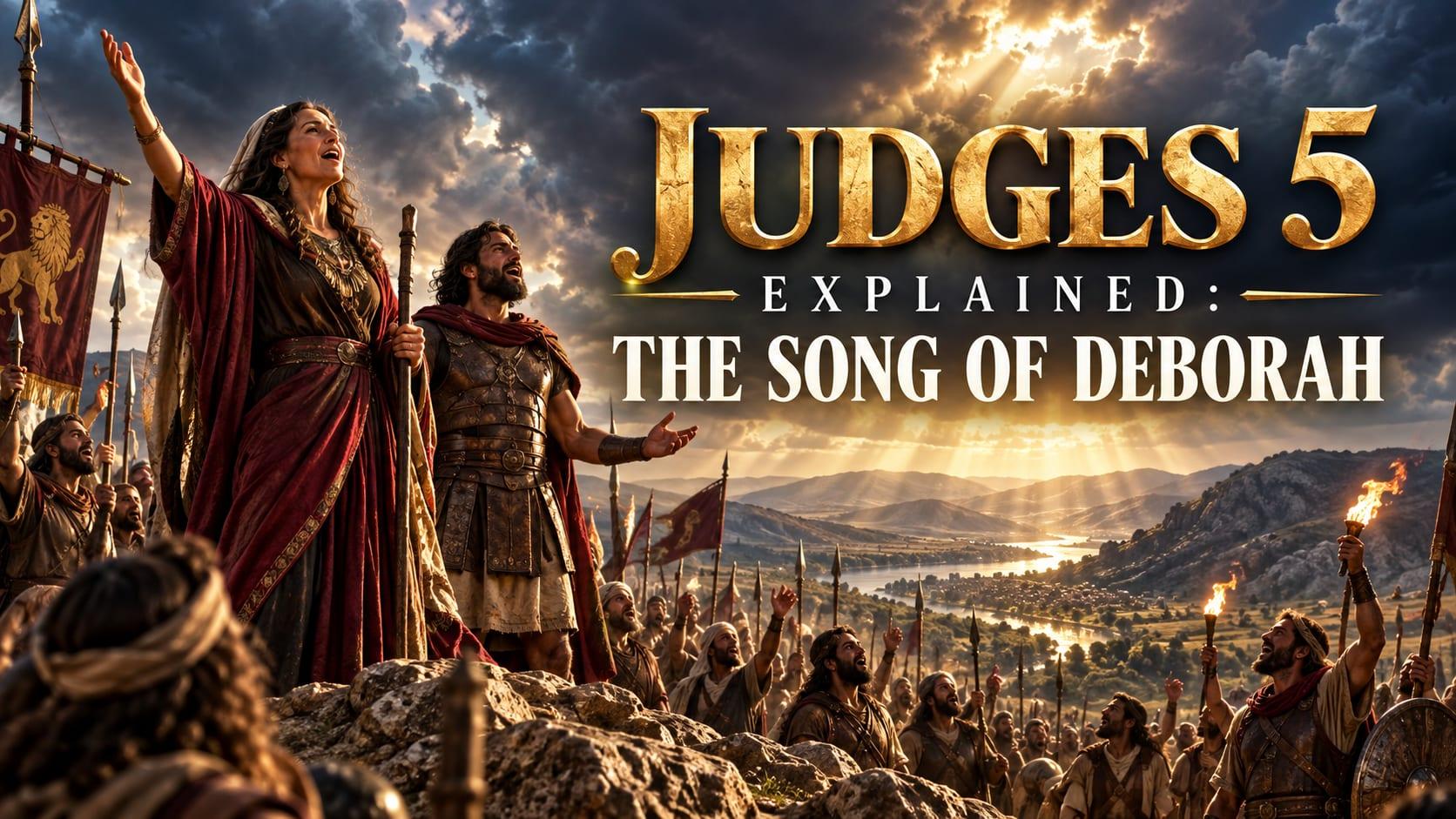
📖 Judges 5 Explained: The Song of Deborah After the Battle
The battle already happened. Sisera is already dead in a tent with a nail through his head. By the end of the last chapter, the war was over.
Judges 5 explained is what Israel does with a victory once the fighting stops. Instead of moving on to the next story, the book pauses for thirty one verses and lets Deborah and Barak sing the whole thing over again, this time as a song instead of a battle report.
Maybe you have lived through something hard enough that telling it once was not enough. You needed to say it again, out loud, in a different way, just to get it to sink in.
- ❓ Why retell a battle Judges 4 already told, and why as a song this time?
- ❓ Why does this song praise some tribes by name and call out others for staying home?
- ❓ Why does one unnamed town get cursed when the rest of the chapter only names people, not places, for blame?
- ❓ Does this song describe Sisera's death the same way the story in Judges 4 did?
📌 This is the only song in the entire book of Judges, and it is sung by the two people who just lived through the war it describes.
This walkthrough goes through the whole chapter in order: the call to sing and the picture of God marching out from Seir, the desperate state of the land before Deborah, the roll call of tribes that answered and the tribes that did not, the battle retold through a storm and a river, and the closing scene at Jael's tent set against a mother waiting at a window many miles away.
Thirty one verses, one battle, and two very different ways of telling the same true story.
What Happened Just Before This Chapter
Judges 4 told the story in order. Israel relapsed after Ehud died, Jabin king of Canaan oppressed them twenty years through his general Sisera and nine hundred iron chariots, and Deborah the prophetess summoned Barak to fight at mount Tabor. Barak would not go without her. Israel won the battle at the river Kishon, Sisera fled on foot to the one tent that should have meant safety, and Jael killed him in his sleep with a tent peg and a hammer.
That chapter ended with a sentence, not a celebration: "So God subdued on that day Jabin the king of Canaan." Judges 5 picks up at the exact same moment and gives the celebration its own verses, in the mouths of the two people most responsible for it.

Judges 5 Explained Verse by Verse
1. The Call to Sing, and a God Who Comes From Seir (verses 1 to 5)
The chapter opens by naming exactly who is singing and why.
"Then sang Deborah and Barak the son of Abinoam on that day, saying,"
💡 "That day" matters. This is not a song written years later to remember an old story. It is sung the same day the battle ended, while the relief and the shock of it are still fresh.
"Praise ye the LORD for the avenging of Israel, when the people willingly offered themselves. Hear, O ye kings; give ear, O ye princes; I, even I, will sing unto the LORD; I will sing praise to the LORD God of Israel."
📌 The song is not aimed only at Israel. Deborah calls kings and princes, foreign rulers who were never part of this war, to listen in. A local rescue gets sung loudly enough for an international audience, because the song believes the God behind it deserves more than a private thank you.
Then the song reaches back past this one battle to describe the LORD Himself on the move.
"LORD, when thou wentest out of Seir, when thou marchedst out of the field of Edom, the earth trembled, and the heavens dropped, the clouds also dropped water. The mountains melted from before the LORD, even that Sinai from before the LORD God of Israel."
⚠️ This is the same picture of God marching out from Seir and Sinai that opens Moses' final blessing in Deuteronomy 33. Deborah is not inventing new language for this victory. She is reaching for the oldest, most familiar language Israel had for God showing up to fight for His people, the same storm and mountain imagery tied to Sinai itself, and applying it to a battle that just happened in her own lifetime.
Singing after a victory was not new either. Moses and Miriam sang at the Red Sea the same way, right after the water closed over Pharaoh's army. Deborah and Barak are standing in a tradition, not starting one.
2. Before Deborah: Empty Roads, New Gods, No Weapons (verses 6 to 8)
Before the song praises anyone, it describes exactly how bad things had gotten.
"In the days of Shamgar the son of Anath, in the days of Jael, the highways were unoccupied, and the travellers walked through byways. The inhabitants of the villages ceased, they ceased in Israel, until that I Deborah arose, that I arose a mother in Israel."
💡 Main roads were not safe to travel, so people took the long way around on back paths instead. Villages emptied out or fell quiet under the pressure. "A mother in Israel" is the title Deborah gives herself, not a boast about leading an army, but a picture of someone who stepped in to protect and provide for a nation that had nowhere else to turn.
The song names the root cause in one blunt line.
"They chose new gods; then was war in the gates: was there a shield or spear seen among forty thousand in Israel?"
📌 "They chose" is the key word. This was not an accident that happened to Israel. It was a decision, the same word Israel's whole history of idolatry keeps coming back to. And the cost of that choice shows up immediately after it: forty thousand people with not a shield or spear between them. Israel was not just spiritually unprepared when Sisera's nine hundred chariots arrived. It was physically unarmed.

3. Remembered Deeds and a Call to Wake Up (verses 9 to 12)
From the bleak picture in verse 8, the song turns to gratitude for the people who did step forward.
Verse 9 says Deborah's heart is toward the governors of Israel who offered themselves willingly, and calls the people to bless the LORD for it. Verses 10 and 11 widen the call further, inviting even the wealthy riders on white asses and the judges who sit hearing cases to retell what the LORD has done, right at the town gates where the whole community would hear it.
💡 Rehearsing God's righteous acts out loud, in public, at the gates, is the song's own answer to the problem Judges 2 already named: a generation that grows up only hearing secondhand reports does not stay faithful the way a generation that watched the works firsthand does. A song sung at the gates the same day it happened is exactly the kind of firsthand telling that generation never got.
"Awake, awake, Deborah: awake, awake, utter a song: arise, Barak, and lead thy captivity captive, thou son of Abinoam."
⚠️ Notice who is being commanded to wake up. Deborah tells herself, by name, to wake up and sing. It is an odd and striking way to write a song, the singer ordering her own voice into action, as if even the woman who already led Israel through this war still had to talk herself into standing up and singing about it.
4. The Muster Roll: Who Came, and Who Stayed Home (verses 13 to 18)
The song now does something no battle report in this book has done before. It calls the tribes out by name, one by one, for showing up or for staying away.
"Out of Ephraim was there a root of them against Amalek; after thee, Benjamin, among thy people; out of Machir came down governors, and out of Zebulun they that handle the pen of the writer. And the princes of Issachar were with Deborah; even Issachar, and also Barak: he was sent on foot into the valley. For the divisions of Reuben there were great thoughts of heart."
💡 Ephraim, Benjamin, Machir, meaning half the tribe of Manasseh, and the officers of Zebulun and Issachar all get named as tribes that sent people or leaders to the fight. Reuben gets named too, but with a very different note attached, "great thoughts of heart," a tribe talking itself into something it never actually did.
The next two verses make Reuben's hesitation explicit, then widen the list of no-shows.
"Why abodest thou among the sheepfolds, to hear the bleatings of the flocks? For the divisions of Reuben there were great searchings of heart. Gilead abode beyond Jordan: and why did Dan remain in ships? Asher continued on the sea shore, and abode in his breaches."
⚠️ Four tribes get called out here: Reuben, Gilead east of the Jordan, Dan, and Asher. None of them are accused of serving another god or breaking a specific command the way earlier chapters describe. Their failure is quieter than that. Reuben stayed with its sheep and talked about it. Gilead, Dan, and Asher stayed exactly where they already were, close to their own flocks, boats, and coastline, while kinsmen a short march away fought for their lives.
Against that backdrop, two tribes get the song's clearest praise.
"Zebulun and Naphtali were a people that jeoparded their lives unto the death in the high places of the field."
📌 Zebulun and Naphtali are exactly the two tribes Judges 4 named as the ones Deborah specifically called to muster at mount Tabor. The song confirms what the narrative already showed: these two tribes did not hold anything back. The rest of the roll call makes clear they were nearly alone in that.

5. The Battle Retold: Stars, Rain, and the River Kishon (verses 19 to 23)
Only now, after the roll call, does the song reach the actual battle, and it tells it differently than Judges 4 did.
"They fought from heaven; the stars in their courses fought against Sisera."
"The river of Kishon swept them away, that ancient river, the river Kishon. O my soul, thou hast trodden down strength."
💡 This answers a question the Judges 4 account left hanging. That chapter never explained why nine hundred iron chariots failed on an open plain. This song does, in poetic language: the stars fighting from their courses pictures a storm breaking over the battlefield, and a storm is exactly what would turn the ground by the Kishon to mud and swallow a chariot's wheels. The same river that should have meant nothing to Sisera's army becomes the thing that sweeps it away.
This is not the only time Scripture describes heaven itself joining a battle on the ground. Joshua 10 records the sun standing still over Gibeon during a different battle for the same land. Both songs agree on the same point: the armies on the ground were never the only thing deciding who won.
"Curse ye Meroz, said the angel of the LORD, curse ye bitterly the inhabitants thereof; because they came not to the help of the LORD, to the help of the LORD against the mighty."
⚠️ Meroz is the only place in this entire song to receive a curse. Four whole tribes were only described, not cursed, for staying home. Whatever Meroz was, a town, a clan, a small settlement near the battle, it is named and condemned in a way even Reuben, Gilead, Dan, and Asher were not. The text never explains exactly what made Meroz's failure worse than theirs, only that it was.
6. Jael Blessed, and a Mother Who Waits at the Window (verses 24 to 31)
Against Meroz's curse, the song sets the highest praise given to anyone in the whole chapter.
"Blessed above women shall Jael the wife of Heber the Kenite be, blessed shall she be above women in the tent."
📌 Jael was not an Israelite and never marched with Barak's army, yet she outranks every tribe just named. Meroz, inside Israel's own covenant, is cursed for doing nothing. Jael, a Kenite with no obligation to this war at all, is blessed above every other woman for what she did inside her own tent.
"He asked water, and she gave him milk; she brought forth butter in a lordly dish. She put her hand to the nail, and her right hand to the workmen's hammer; and with the hammer she smote Sisera, she smote off his head, when she had pierced and stricken through his temples."
💡 The song adds a detail Judges 4 never mentioned, the butter served in a lordly dish, a small picture of exactly how comfortable and well cared for Sisera felt right before he died. The killing itself is described twice in the same breath, "smote off his head" and "pierced and stricken through his temples." Hebrew poetry regularly piles up two images of one violent act to stress how total it was, rather than reporting two separate blows, and the detail that matches Judges 4 exactly, a weapon driven through the temples while he slept, stays the same in both tellings.
Far from the battlefield, the song shifts to a very different scene.
"The mother of Sisera looked out at a window, and cried through the lattice, Why is his chariot so long in coming? why tarry the wheels of his chariots?"
⚠️ The song pauses its own celebration to picture the enemy general's mother, still waiting, still hopeful, asking a question the reader already knows the terrible answer to. Her ladies answer her with a confident guess about dividing up Israelite plunder, a guess the whole chapter has already proven wrong. It is a brief, almost uncomfortable moment of sympathy inside a song that otherwise has no doubt whose side was right.
The song closes by turning one family's grief back into a prayer for everyone watching.
"So let all thine enemies perish, O LORD: but let them that love him be as the sun when he goeth forth in his might. And the land had rest forty years."
📌 That final sentence, forty years of rest, is the number Judges 4 never gave you. That chapter ended at the victory itself, with no count of years afterward. The song supplies it, closing the loop on a story that took two full chapters to finish telling.

Hard Questions Judges 5 Raises
Does "she smote off his head" in verse 26 contradict the tent peg through the temples in Judges 4:21? What the text says: verse 26 names both images, a head struck and temples pierced, inside the same two lines of poetry. How this is read: Hebrew poetry regularly stacks more than one picture of a single violent act to stress its force, rather than describing two separate events. The detail both chapters agree on without variation, a weapon driven through Sisera's head while he lay asleep, stays constant. The song is not correcting the story. It is singing the same death with more intensity.
Why are Reuben, Gilead, Dan, and Asher blamed for not fighting when Judges 4:6 only names Zebulun and Naphtali as the tribes Deborah actually summoned? What the text says: the narrative in Judges 4 records a specific call to two tribes; the song in Judges 5 names four different tribes for staying home as if the danger concerned them too. How this is read: an oppressor strong enough to hold the whole region twenty years was read as a threat to every tribe under the same covenant, not only the ones closest to the fighting. The song does not claim these four tribes broke a direct command. It judges them for treating a shared danger as someone else's problem.
Why does Meroz receive the only curse in this song when whole tribes are only described, not cursed, for the same kind of absence? What the text says: verse 23 singles out Meroz by name for a curse pronounced by the angel of the LORD, with no explanation of who they were or why their failure outweighed Reuben's or Dan's. How this is read: Meroz's exact identity and location are lost to history, and Bible teachers do not claim to know what set it apart. What the text preserves clearly is the principle rather than the geography: refusing real, nearby help to God's people in a moment of crisis is judged more harshly than simply staying distant and uninvolved.
Why does a victory song pause to picture the grief of the losing side's mother in verses 28 to 30? What the text says: the song shifts without warning from Jael's tent to Sisera's mother watching for a chariot that will never arrive. How this is read: many readers take this as the song being honest about what war costs, even the side that deserved to lose, without walking back its own verdict that this deliverance was just. The next line returns straight to that verdict, praying that all of God's enemies would perish the same way. The sympathy and the judgment sit side by side, and the song does not resolve the tension between them for you.
Top Verses From Judges 5
1. Judges 5:7
"The inhabitants of the villages ceased, they ceased in Israel, until that I Deborah arose, that I arose a mother in Israel."
Deborah's own title for herself, not a warrior's boast but a picture of stepping into a gap that had emptied villages and silenced an entire nation.
2. Judges 5:12
"Awake, awake, Deborah: awake, awake, utter a song: arise, Barak, and lead thy captivity captive, thou son of Abinoam."
The singer commanding her own voice into action, proof that even the woman who already led Israel through this war still had to talk herself into singing about it.
3. Judges 5:20 and 21
"They fought from heaven; the stars in their courses fought against Sisera. The river of Kishon swept them away, that ancient river, the river Kishon."
The answer the Judges 4 battle report never gave: a storm from heaven, not Israel's own strength, is what turned nine hundred chariots into nothing.
4. Judges 5:23
"Curse ye Meroz, said the angel of the LORD, curse ye bitterly the inhabitants thereof; because they came not to the help of the LORD, to the help of the LORD against the mighty."
The only curse in the whole song, aimed not at an enemy nation but at people who simply never showed up to help their own.
5. Judges 5:24
"Blessed above women shall Jael the wife of Heber the Kenite be, blessed shall she be above women in the tent."
The highest praise in the chapter, given to a woman with no tribe, no summons, and no obligation to this war at all.
Frequently Asked Questions About Judges 5
What happened in Judges 5?
Deborah and Barak sang a victory song the same day Israel defeated Sisera and Jabin, retelling the war from Judges 4 in poetry. The song pictures God marching out to fight, describes how desperate Israel was before Deborah rose up, names which tribes answered the call and which stayed home, credits a storm from heaven and the river Kishon with breaking Sisera's army, curses the town of Meroz for refusing to help, and blesses Jael above every other woman for killing Sisera in her tent.
What is the Song of Deborah?
It is the common name for Judges 5, a victory hymn sung by Deborah and Barak right after the battle described in Judges 4. It is the only song recorded in the entire book of Judges, and one of the oldest pieces of Hebrew poetry in the Bible.
Why does Judges 5 retell the same battle as Judges 4?
Judges 4 tells the events in order as a narrative. Judges 5 celebrates the same events as poetry, the way Moses and Miriam sang after the Red Sea in Exodus 15. Ancient Israel regularly followed a major deliverance with both a record of what happened and a song meant to be remembered and repeated.
Does Judges 5 contradict how Sisera died in Judges 4?
No. Both chapters agree that a weapon was driven through Sisera's temples while he slept. Judges 5:26 adds the poetic phrase "smote off his head" alongside that detail, which Hebrew poetry uses to stress how total the blow was rather than to describe a second, different act.
Why does Judges 5 curse Meroz?
Verse 23 records the angel of the LORD cursing Meroz for not coming to help against Sisera's army. Scripture never explains exactly who Meroz was or where it stood, but the curse marks their absence as worse than the other tribes who are only described, not cursed, for staying home.
Which tribes are blamed for not fighting in Judges 5?
Verses 16 and 17 name Reuben, Gilead, Dan, and Asher as tribes that stayed where they already were, with their flocks, boats, and coastline, instead of joining the battle. Zebulun and Naphtali, by contrast, are praised in verse 18 for risking their lives in the fight.
What does "a mother in Israel" mean?
Deborah uses this title for herself in verse 7, describing someone who stepped in to protect and provide for a nation left defenseless, not a claim to being a literal mother to the whole country. It is a picture of care and leadership together.
Why does the song mention Sisera's mother?
Verses 28 through 30 picture her waiting at a window for a chariot that will never return. The song uses this scene to show the real human cost of the war even on the losing side, before returning in the very next verse to praying that God's enemies would perish the same way.
What does it mean that "the stars fought against Sisera"?
Verse 20 uses this picture of heaven itself joining the fight to describe a storm breaking over the battlefield. That storm is what most readers connect to the river Kishon sweeping Sisera's chariots away in the very next verse, answering a question Judges 4 never explained.
How does Judges 5 connect to other songs in the Bible?
Its opening picture of God marching out from Seir and Sinai echoes Moses' blessing in Deuteronomy 33, and its practice of singing right after a battlefield deliverance follows the same pattern as Moses and Miriam's song at the Red Sea in Exodus 15. Judges 5 stands in a long line of victory songs, not as something new to this book.
Final Thoughts
Judges 5 proves that telling a true story once is not always enough.
📌 A rescue remembered only as fact fades faster than one turned into song. Deborah and Barak did not just record what happened. They set it to words meant to be sung again at the gates, long after the battle itself was forgotten in detail.
📌 Showing up for your own people gets remembered by name, and so does staying home. Zebulun and Naphtali, who risked everything, and Reuben, Gilead, Dan, and Asher, who did not, are all named in the same breath, for very different reasons.
📌 Even a victory this complete still makes room for the cost of it. The song praises Jael above every woman and still pauses, a few verses later, to picture the grief its own ending caused.
You have probably seen God come through for you at some point and then let the memory of it go quiet, told once and never mentioned again.
So here is your one next step.
Say one specific thing God has done for you out loud to another person this week, the way Deborah sang hers the same day it happened, instead of keeping it as a private fact you never rehearse.