📖 Judges 11 Explained: Jephthah's Outcast Rise and His Costly Vow
A son thrown out of his own house becomes the man his whole family needs. Then one sentence he never had to say costs him everything that sentence touched.
Judges 11 explained is one of the longest chapters in the whole book, forty verses, and it spends most of that length on words, not weapons. Jephthah argues his way into leadership before he ever lifts a sword, argues his way through a diplomatic exchange with a foreign king, and then speaks one unnecessary vow that the rest of the chapter will not let him take back.
Maybe you have watched someone make a promise under pressure that nobody asked them to make, and then watched them keep it anyway, long after it stopped making sense to.
- ❓ Why did Jephthah's own brothers throw him out, and why did they come begging him back?
- ❓ Why does he spend seventeen verses arguing history with the king of Ammon before a single battle happens?
- ❓ The Spirit of the LORD already came on him in verse 29. So why does he still make a vow in verse 30?
- ❓ What actually happened to his daughter, and does the Bible really say God wanted it?
📌 Judges 11 is the chapter where a man already carrying God's Spirit still reaches for a bargain God never asked him to make, and then will not let himself off the hook he built.
This walkthrough goes through the whole chapter in order: Jephthah's birth and rejection, the elders of Gilead coming to the man they once cast out, his long case against the king of Ammon, the vow spoken on his way to battle, the victory itself, and the daughter who walked out of his house first.
Forty verses, one outcast made judge, and a promise that outlives the war it was meant to win.
What Happened Just Before This Chapter
Judges 10 ended on an open question nobody in Gilead could answer. Ammon had camped for war, Israel had gathered at Mizpeh to meet them, and the region's own princes were left asking each other who would even start the fight, offering headship over all of Gilead as the prize to whoever did. God had already said He would deliver Israel no more, then relented once Israel actually put away its foreign gods. The relief was real. The commander was not yet found.
Judges 11 answers that open question with a name nobody in Gilead expected to need: a son already living outside the family that should have claimed him.

Judges 11 Explained Verse by Verse
1. Jephthah: Born Outside, Driven Further Out (verses 1 to 3)
The chapter opens with a man already carrying two marks against him before he does anything at all.
"Now Jephthah the Gileadite was a mighty man of valour, and he was the son of an harlot: and Gilead begat Jephthah."
💡 The text names his strength and his shame in the same breath. He is a mighty man of valour, and he is the son of a harlot, both true, both recorded without softening either one.
"And Gilead's wife bare him sons; and his wife's sons grew up, and they thrust out Jephthah, and said unto him, Thou shalt not inherit in our father's house; for thou art the son of a strange woman."
📌 His own brothers, not strangers, are the ones who throw him out, and they say it to his face. "Strange woman" marks his mother as an outsider to the family line, and that is reason enough for them to cut him out of the inheritance entirely. Nothing in the text suggests Jephthah did anything to deserve it. The exclusion is about his birth, not his character.
"Then Jephthah fled from his brethren, and dwelt in the land of Tob: and there were gathered vain men to Jephthah, and went out with him."
⚠️ "Vain men" is the same description Judges 9 used for the mercenaries Abimelech hired to murder his own brothers. The word points to men with nothing to lose, not to any particular crime. Jephthah gathers the same kind of following Abimelech did, but nothing in this chapter shows him turning them toward his own family's blood. Two outcasts, two bands of reckless men, two very different uses for them.
2. The Elders Who Cast Him Out Come Asking (verses 4 to 11)
War arrives, and Gilead remembers the man it exiled.
"And it was so, that when the children of Ammon made war against Israel, the elders of Gilead went to fetch Jephthah out of the land of Tob: And they said unto Jephthah, Come, and be our captain, that we may fight with the children of Ammon."
Jephthah does not pretend the history between them is settled.
"And Jephthah said unto the elders of Gilead, Did not ye hate me, and expel me out of my father's house? and why are ye come unto me now when ye are in distress?"
💡 He does not deny their offer. He makes them say out loud what they are actually doing: coming to the man they rejected only now that rejecting him costs them nothing and keeping him alive might save them.
"And the elders of Gilead said unto Jephthah, Therefore we turn again to thee now, that thou mayest go with us, and fight against the children of Ammon, and be our head over all the inhabitants of Gilead."
📌 "Head over all the inhabitants of Gilead" is the exact phrase the princes used at Mizpeh in Judges 10:18 when they asked who would even begin the fight. Jephthah is the answer to that open question, word for word. But he does not accept on the spot. He pushes for something more binding than a battlefield promise.
"And Jephthah said unto the elders of Gilead, If ye bring me home again to fight against the children of Ammon, and the LORD deliver them before me, shall I be your head?"
"And the elders of Gilead said unto Jephthah, The LORD be witness between us, if we do not so according to thy words."
"Then Jephthah went with the elders of Gilead, and the people made him head and captain over them: and Jephthah uttered all his words before the LORD in Mizpeh."
💡 Jephthah will not simply trust the elders' word a second time. He makes them swear it before the LORD, the same God he will soon speak to far too freely in a different kind of promise. He has already learned, the hard way, what an unguarded promise from his own family cost him.

3. Jephthah's Case Against the King of Ammon (verses 12 to 28)
Before any army moves, Jephthah does something no other judge in this book bothers to do. He sends messengers and argues.
"And Jephthah sent messengers unto the king of the children of Ammon, saying, What hast thou to do with me, that thou art come against me to fight in my land?"
"And the king of the children of Ammon answered unto the messengers of Jephthah, Because Israel took away my land, when they came up out of Egypt, from Arnon even unto Jabbok, and unto Jordan: now therefore restore those lands again peaceably."
💡 Ammon's claim is simple: that land is ours, give it back. Jephthah's answer, stretched across the next fifteen verses, is a history lesson built entirely on what already happened generations earlier, the same history Numbers 21 records.
"Then Israel sent messengers unto the king of Edom, saying, Let me, I pray thee, pass through thy land: but the king of Edom would not hearken thereto. And in like manner they sent unto the king of Moab: but he would not consent: and Israel abode in Kadesh."
"And the LORD God of Israel delivered Sihon and all his people into the hand of Israel, and they smote them: so Israel possessed all the land of the Amorites, the inhabitants of that country."
📌 The land in dispute never belonged to Ammon at all, by Jephthah's own account. Israel asked Edom and Moab for peaceful passage and was refused by both. It was Sihon, king of the Amorites, who attacked Israel outright, and it was Sihon's land Israel took after God gave Israel the victory. Ammon is claiming ground that changed hands between two other nations before Israel ever touched it.
"Wilt not thou possess that which Chemosh thy god giveth thee to possess? So whomsoever the LORD our God shall drive out from before us, them will we possess."
⚠️ Chemosh was the national god most associated with Moab elsewhere in Scripture, not Ammon, whose god is usually named Milcom. Jephthah may be grouping both kindred nations, Ammon and Moab, under the claim together, since the two peoples and their territories were closely tied. Either way, his point does not depend on getting a foreign god's name right. It depends on a simple argument: if Ammon believes its own god gave it land, Israel can say the same of the LORD, and three hundred years of silence while Israel lived on that ground only strengthens Israel's claim.
"While Israel dwelt in Heshbon and her towns, and in Aroer and her towns, and in all the cities that be along by the coasts of Arnon, three hundred years? why therefore did ye not recover them within that time?"
💡 Three centuries of unchallenged occupation is Jephthah's closing argument. If the land were truly stolen, why does Ammon wait this long to say so? The king of Ammon never answers the question.
"Howbeit the king of the children of Ammon hearkened not unto the words of Jephthah which he sent him."

4. The Spirit Comes, Then a Vow Nobody Required (verses 29 to 31)
Diplomacy fails. What happens next moves fast, and in an order worth slowing down to notice.
"Then the Spirit of the LORD came upon Jephthah, and he passed over Gilead, and Manasseh, and passed over Mizpeh of Gilead, and from Mizpeh of Gilead he passed over unto the children of Ammon."
📌 Read that verse again before the next one. The Spirit of the LORD is already on Jephthah, already moving him toward Ammon, before a single word of the vow is spoken. Whatever happens next is not the price of getting God's help. God's help has already arrived.
"And Jephthah vowed a vow unto the LORD, and said, If thou shalt without fail deliver the children of Ammon into mine hands, Then it shall be, that whatsoever cometh forth of the doors of my house to meet me, when I return in peace from the children of Ammon, shall surely be the LORD's, and I will offer it up for a burnt offering."
⚠️ Nobody asks Jephthah for this vow. Not the elders, not God, not the moment. The word "whatsoever" is open ended, which strongly suggests he was picturing an animal from his own household wandering out to greet him, the kind of thing that could sensibly become a burnt offering. He speaks it anyway, adding a bargain to a victory the Spirit of the LORD had already set in motion the verse before.
5. Victory Over Ammon (verses 32 and 33)
The battle itself takes two verses. The diplomacy took seventeen. The vow took two. The fighting is almost an afterthought by comparison.
"So Jephthah passed over unto the children of Ammon to fight against them; and the LORD delivered them into his hands."
"And he smote them from Aroer, even till thou come to Minnith, even twenty cities, and unto the plain of the vineyards, with a very great slaughter. Thus the children of Ammon were subdued before the children of Israel."
💡 Twenty cities and a clear, total win. The text does not credit the vow for any of it. It credits the LORD delivering Ammon into Jephthah's hand, the same language already set up by the Spirit coming upon him in verse 29.
6. The Daughter Who Came Out First (verses 34 to 40)
Jephthah comes home to the exact celebration a victorious commander would expect, except for who is leading it.
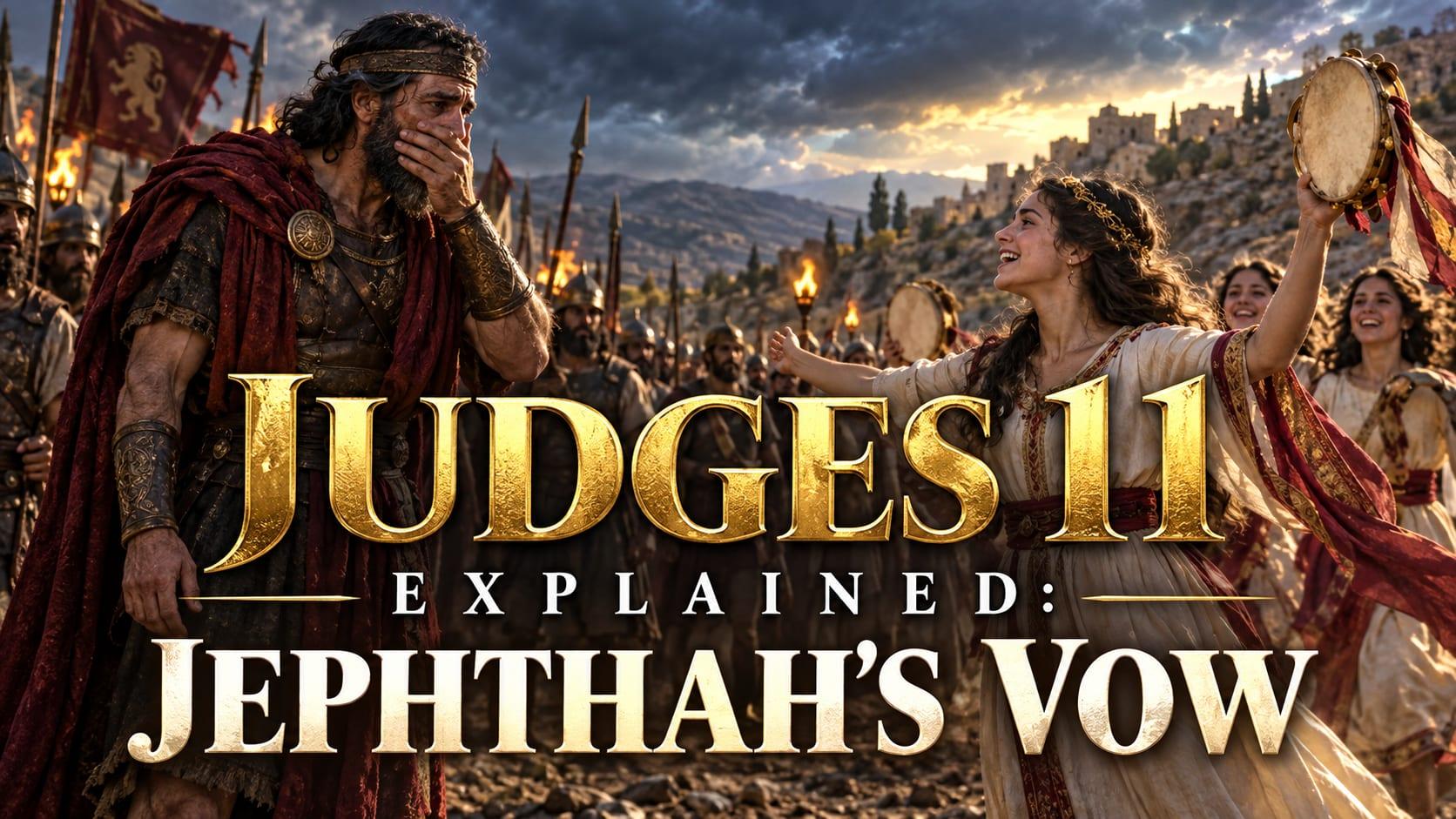
"And Jephthah came to Mizpeh unto his house, and, behold, his daughter came out to meet him with timbrels and with dances: and she was his only child; beside her he had neither son nor daughter."
📌 Timbrels and dances were how Israel's women customarily greeted a victorious army home. His daughter is doing exactly what she should do, celebrating her father's win the way daughters and wives across Scripture celebrated theirs. She is also, the verse makes clear twice, his only child.
"And it came to pass, when he saw her, that he rent his clothes, and said, Alas, my daughter! thou hast brought me very low, and thou art one of them that trouble me: for I have opened my mouth unto the LORD, and I cannot go back."
⚠️ He blames her for coming out first, in the same breath as admitting the vow was his own mouth's doing. "I cannot go back" is the chapter's hinge. He treats an unnecessary vow as more binding than mercy toward his only child.
"And she said unto him, My father, if thou hast opened thy mouth unto the LORD, do to me according to that which hath proceeded out of thy mouth; forasmuch as the LORD hath taken vengeance for thee of thine enemies, even of the children of Ammon."
💡 She answers before he even asks her to. No pleading, no argument, only a daughter accepting a cost her father created and she did not choose. The text gives her a voice here, and it is worth noticing that it does.
"And she said unto her father, Let this thing be done for me: let me alone two months, that I may go up and down upon the mountains, and bewail my virginity, I and my fellows."
"And it came to pass at the end of two months, that she returned unto her father, who did with her according to his vow which he had vowed: and she knew no man."
📌 Verse 39 is deliberately spare. It states only that Jephthah did according to his vow, and that she never married. It does not restate the word "burnt offering" from verse 31, and it does not describe what actually happened in the moment he carried the vow out.
"That the daughters of Israel went yearly to lament the daughter of Jephthah the Gileadite four days in a year."
💡 The chapter's final verse is a memorial, not a battle report. An unnamed girl becomes the reason an entire generation of Israel's daughters sets aside four days a year, every year, to remember her.

Hard Questions Judges 11 Raises
Did Jephthah actually kill his daughter as a burnt offering? What the text says: verse 31 states the vow in those words, and verse 39 says only that he did according to his vow and that she never married. How this is read: some Bible teachers read verse 39 as confirming the literal sacrifice the vow promised, since "according to his vow" points straight back to "a burnt offering" in verse 31. Others read her bewailing her virginity, and the fact that the memory kept by Israel's daughters is her unmarried state rather than her death, as evidence she was given to lifelong service and perpetual virginity instead, a reading Numbers 30 also leaves open. Judges itself never states plainly which one happened.
Does this chapter mean God wanted or approved human sacrifice? What the text says: nothing in Judges 11 has God requesting, commanding, or praising the vow at any point. How this is read: the law given through Moses is direct about this elsewhere, condemning child sacrifice in passages like Leviticus 20. Whatever Jephthah carried out, Scripture records it as his own vow, spoken under pressure and kept out of a sense of obligation, not as something God asked for or sanctioned.
If the Spirit of the LORD was already on Jephthah in verse 29, why did he still make a vow in verse 30? What the text says: the Spirit coming upon him and the vow being spoken are two separate, consecutive verses, with the empowering coming first. How this is read: many Bible teachers see this as Jephthah adding a bargain God never required, not unlike Gideon asking for signs with the fleece in an earlier chapter. The victory that follows is credited to the LORD delivering Ammon into his hand, not to the vow securing anything that was not already in motion.
Why does Jephthah call Chemosh the god of Ammon, when other parts of Scripture connect Chemosh with Moab? What the text says: verse 24 names Chemosh as "thy god," speaking to Ammon's king. How this is read: Ammon and Moab were closely related peoples with overlapping territory and history, and some readers take Jephthah's wording as grouping the two together in his argument rather than making a precise claim about which nation worshipped which god. The force of his case does not rest on the god's name; it rests on three hundred years of unchallenged Israelite possession of the land in question.
Top Verses From Judges 11
1. Judges 11:7
"And Jephthah said unto the elders of Gilead, Did not ye hate me, and expel me out of my father's house? and why are ye come unto me now when ye are in distress?"
The man they threw out makes them say the truth about why they are suddenly back, before he ever agrees to help them.
2. Judges 11:29
"Then the Spirit of the LORD came upon Jephthah, and he passed over Gilead, and Manasseh, and passed over Mizpeh of Gilead, and from Mizpeh of Gilead he passed over unto the children of Ammon."
The verse that changes how the whole vow should be read. Help had already arrived before Jephthah ever opened his mouth to bargain for it.
3. Judges 11:31
"Then it shall be, that whatsoever cometh forth of the doors of my house to meet me, when I return in peace from the children of Ammon, shall surely be the LORD's, and I will offer it up for a burnt offering."
A vow spoken wide open, without naming what it might actually cost, moments after the Spirit of the LORD had already set the victory in motion.
4. Judges 11:35
"And it came to pass, when he saw her, that he rent his clothes, and said, Alas, my daughter! thou hast brought me very low, and thou art one of them that trouble me: for I have opened my mouth unto the LORD, and I cannot go back."
A father treats his own unnecessary promise as more unbreakable than the life standing in front of him.
5. Judges 11:36
"And she said unto him, My father, if thou hast opened thy mouth unto the LORD, do to me according to that which hath proceeded out of thy mouth; forasmuch as the LORD hath taken vengeance for thee of thine enemies, even of the children of Ammon."
The clearest voice in the whole chapter belongs to the one person who had no say in the vow that now defines her.
Frequently Asked Questions About Judges 11
What happened in Judges 11?
Jephthah, rejected by his own brothers and driven out of his father's house, was called back by the elders of Gilead to lead Israel against the invading Ammonites. He tried diplomacy first, arguing a detailed history of the disputed land, and when that failed he vowed that whatever came out of his house to meet him after the battle would be offered to the LORD. He won a decisive victory, then returned home to find his only child, his daughter, coming out first.
Who was Jephthah in the Bible?
Jephthah was a Gileadite judge, the son of a man named Gilead and a woman the text calls a harlot. His half brothers forced him out of the family inheritance for being the son of an outsider, and he later became the leader Gilead needed when the children of Ammon made war against Israel.
Why was Jephthah rejected by his brothers?
Verse 2 says his brothers told him he could not inherit in their father's house because he was the son of a "strange woman," meaning a woman outside their own family line. The rejection was about his mother's status, not anything Jephthah had done.
What was Jephthah's vow in Judges 11?
Before fighting Ammon, Jephthah vowed in verses 30 and 31 that if the LORD gave him victory, whatever came out of the doors of his house to meet him when he returned would belong to the LORD and be offered as a burnt offering. His own daughter was the one who came out first.
Did Jephthah really sacrifice his daughter?
Bible teachers disagree. Verse 39 only says he did according to his vow and that she never married, without repeating the words "burnt offering" from verse 31. Some read that as confirming a literal sacrifice. Others read her unmarried state and the yearly memorial by Israel's daughters as evidence she was given to lifelong dedicated service instead. The text itself does not settle it either way.
Why did Jephthah make a vow if the Spirit of the LORD was already on him?
Verse 29 says the Spirit of the LORD came upon Jephthah and sent him toward Ammon before he spoke a single word of the vow in verse 30. Many Bible teachers read the vow as an unnecessary bargain he added on his own, since the victory that followed is credited to the LORD delivering Ammon into his hand, not to anything the vow secured.
Does the Bible praise Jephthah anywhere else?
Hebrews 11 lists Jephthah among a roll call of people commended for their faith, grouped there for trusting God to act through them in impossible circumstances. That later commendation is about his faith to fight when Gilead needed a deliverer, not an endorsement of every choice recorded about him in Judges 11.
Why does Jephthah mention the god Chemosh when talking to the king of Ammon?
Chemosh is named in verse 24 as the god Jephthah attributes to Ammon's king, though other parts of Scripture usually connect Chemosh with the closely related nation of Moab. Jephthah's argument does not depend on the god's exact name; it depends on three hundred years of Israel holding the land without Ammon ever challenging it.
How does Judges 11 connect to Numbers 21?
Jephthah's entire argument to Ammon's king retells the events Numbers 21 records: Edom and Moab refusing Israel safe passage, and Sihon king of the Amorites attacking Israel and losing his land as a result. Jephthah uses that older history to prove the disputed territory was never Ammon's to begin with.
Final Thoughts
Judges 11 gives its longest sections to words, not battles, because the words are where this chapter actually does its damage.
📌 Being thrown out by your own family does not mean you are outside God's purposes. The same brothers who cut Jephthah out of the inheritance are the ones who need him to save them. Rejection by people is not the same thing as rejection by God.
📌 God's help can already be on its way before you think to ask for it. The Spirit of the LORD came upon Jephthah one verse before his vow, not because of it. Watch for what has already started moving before you reach for a bargain to make it move.
📌 Words spoken in a rush can outlast every intention behind them. Jephthah treated an unnecessary promise as more fixed than mercy toward his own child, and the chapter lets that cost stand without softening it.
You may have made a promise once, under pressure, that you are still carrying the weight of.
So here is your one next step.
Before your next promise to God leaves your mouth, ask whether He actually asked for it, or whether you are only trying to earn something He already started giving.