📖 Judges 16 Explained: Delilah, Blindness, and One Last Prayer
A man strong enough to tear a city gate off its hinges cannot see the one lie that will actually take him down.
Judges 16 explained is the last chapter of Samson's story, and it holds three scenes that barely seem to belong together: a reckless night in Gaza, a slow four part seduction by a woman named Delilah, and a prison cell that ends in the single most famous death in the whole book of Judges.
Maybe you have given pieces of something sacred away a little at a time, telling yourself each piece was too small to matter.
- ❓ Why does Samson finally tell Delilah the truth after dodging her three times already?
- ❓ Was his strength really hidden in his hair, or was it something else entirely?
- ❓ What does it mean that Samson "wist not that the LORD was departed from him"?
- ❓ How does a blind prisoner bring down an entire temple?
📌 Judges 16 is the chapter where a man who once tore a lion apart with his bare hands finally loses, not to an army, but to his own willingness to keep handing away what was never his to give.
This walkthrough goes through the whole chapter in order: the stolen gate of Gaza, Delilah's bribe, the four attempts to learn Samson's secret, the haircut that ends it, the blinding and the grinding, the hair that quietly starts growing back, and the prayer in the dark that brings down the temple of Dagon with him inside it.
Thirty one verses, one secret given away in pieces, and a death that undoes a lifetime of victories in a single afternoon.
What Happened Just Before This Chapter
Judges 15 closed with Samson free, victorious, and drinking from a spring God opened in answer to his own desperate prayer at Lehi. The chapter ended on a line usually saved for the very last word on a judge's life: he had judged Israel twenty years.
Judges 16 explained picks up with no sign that Samson learned anything from how close that chapter came to ending him. He is still chasing women outside his own people, still trusting his own strength to cover for it, and still treating his set apart calling as something he can play with instead of keep.

Judges 16 Explained Verse by Verse
1. Gaza, a Harlot, and a Stolen Gate (verses 1 to 3)
The chapter opens with Samson deep inside enemy territory, for no reason the text calls noble.
"Then went Samson to Gaza, and saw there an harlot, and went in unto her."
💡 Gaza sat roughly forty miles from Samson's home territory, well inside Philistine land. He has not been sent there and has not been called there. He has simply gone, the same pattern of unchecked wanting that opened Judges 14.
Word travels fast, and his enemies set a trap.
"And it was told the Gazites, saying, Samson is come hither. And they compassed him in, and laid wait for him all night in the gate of the city, and were quiet all the night, saying, In the morning, when it is day, we shall kill him."
"And Samson lay till midnight, and arose at midnight, and took the doors of the gate of the city, and the two posts, and went away with them, bar and all, and put them upon his shoulders, and carried them up to the top of an hill that is before Hebron."
📌 Samson walks out of an ambush carrying an entire city gate on his shoulders, uphill, for roughly forty miles. It is one of the clearest shows of strength in the whole book, and it happens the same night he put himself in danger on purpose. Nothing in this opening has slowed him down yet.
2. Delilah and the Bribe (verses 4 and 5)
The next woman in Samson's story is not a one night risk. She is a relationship the Philistines decide to use.
"And it came to pass afterward, that he loved a woman in the valley of Sorek, whose name was Delilah."
"And the lords of the Philistines came up unto her, and said unto her, Entice him, and see wherein his great strength lieth, and by what means we may prevail against him, that we may bind him to afflict him: and we will give thee every one of us eleven hundred pieces of silver."
💡 This is the only woman in Samson's story the text actually says he loved, which makes what follows harder to read, not easier. The five Philistine lords each promise her eleven hundred pieces of silver, a strange, specific sum that turns out to match exactly what gets taken from a mother in the very next chapter of Judges. Scripture never explains why the number repeats. It is simply there for a reader paying attention.
Unlike his first wife in Judges 14, Delilah is never shown facing a threat. She is offered money, and she takes it.
3. Three Lies That Almost Worked (verses 6 to 14)
What follows is not one attempt but a pattern, repeated three separate times before the real answer ever comes out.
"And Delilah said to Samson, Tell me, I pray thee, wherein thy great strength lieth, and wherewith thou mightest be bound to afflict thee."
"And Samson said unto her, If they bind me with seven green withs that were never dried, then shall I be weak, and be as another man."
💡 Withs were pliable branches, strong enough to bind a normal man even before they dried out and stiffened. Samson names a real material. He just lies about what it can do to him.
"Then the lords of the Philistines brought up to her seven green withs which had not been dried, and she bound him with them."
"Now there were men lying in wait, abiding with her in the chamber. And she said unto him, The Philistines be upon thee, Samson. And he brake the withs, as a thread of tow is broken when it toucheth the fire. So his strength was not known."
⚠️ There are men hiding in the room with Delilah, ready to seize Samson the moment the withs hold. He breaks free as if the branches were burnt thread and seems to notice nothing wrong. He keeps coming back to the same woman who is clearly setting traps for him.
"And Delilah said unto Samson, Behold, thou hast mocked me, and told me lies: now tell me, I pray thee, wherewith thou mightest be bound. And he said unto her, If they bind me fast with new ropes that never were occupied, then shall I be weak, and be as another man."
"Delilah therefore took new ropes, and bound him therewith, and said unto him, The Philistines be upon thee, Samson. And there were liers in wait abiding in the chamber. And he brake them from off his arms like a thread."
"And Delilah said unto Samson, Hitherto thou hast mocked me, and told me lies: tell me wherewith thou mightest be bound. And he said unto her, If thou weavest the seven locks of my head with the web."
"And she fastened it with the pin, and said unto him, The Philistines be upon thee, Samson. And he awaked out of his sleep, and went away with the pin of the beam, and with the web."
📌 Samson keeps circling closer to the real secret without ever naming it. Ropes are still just ropes, but the third lie reaches all the way to his own hair, woven into a loom while he sleeps. He is not protecting the secret anymore so much as playing with how near he can get to it. This is the third time in two chapters a number like this has mattered in Samson's story, after the three days no one could solve his riddle in Judges 14 and the three thousand men of his own tribe in Judges 15.
4. Vexed Unto Death, and the Secret at Last (verses 15 to 17)
Delilah changes tactics. Instead of another test, she makes it personal.
"And she said unto him, How canst thou say, I love thee, when thine heart is not with me? thou hast mocked me these three times, and hast not told me wherein thy great strength lieth."
"And it came to pass, when she pressed him daily with her words, and urged him, so that his soul was vexed unto death;"
⚠️ "Vexed unto death" is the same kind of pressure his first wife used on him back in Judges 14, daily words wearing him down until giving in feels easier than holding out. The difference is that his first wife faced a death threat against her own family. Delilah is doing this for silver. Samson falls for the exact same pressure twice, from two very different women, for two very different reasons on their side.
"That he told her all his heart, and said unto her, There hath not come a razor upon mine head; for I have been a Nazarite unto God from my mother's womb: if I be shaven, then my strength will go from me, and I shall become weak, and be like any other man."
📌 This time Samson tells the truth, and the truth he gives away is the one thing he never chose for himself in the first place. The Nazarite vow was spoken over him before he was even born, in Judges 13. Growing his hair was never the point of the vow. It was the visible sign of a life set apart to God. Samson is the one who finally hands that sign over to the people it was supposed to set him apart from.
5. Shaved, Blind, and Grinding in the Dark (verses 18 to 22)
Delilah knows this time is different the moment she hears it.
"And when Delilah saw that he had told her all his heart, she sent and called for the lords of the Philistines, saying, Come up this once, for he hath shewed me all his heart. Then the lords of the Philistines came up unto her, and brought money in their hand."
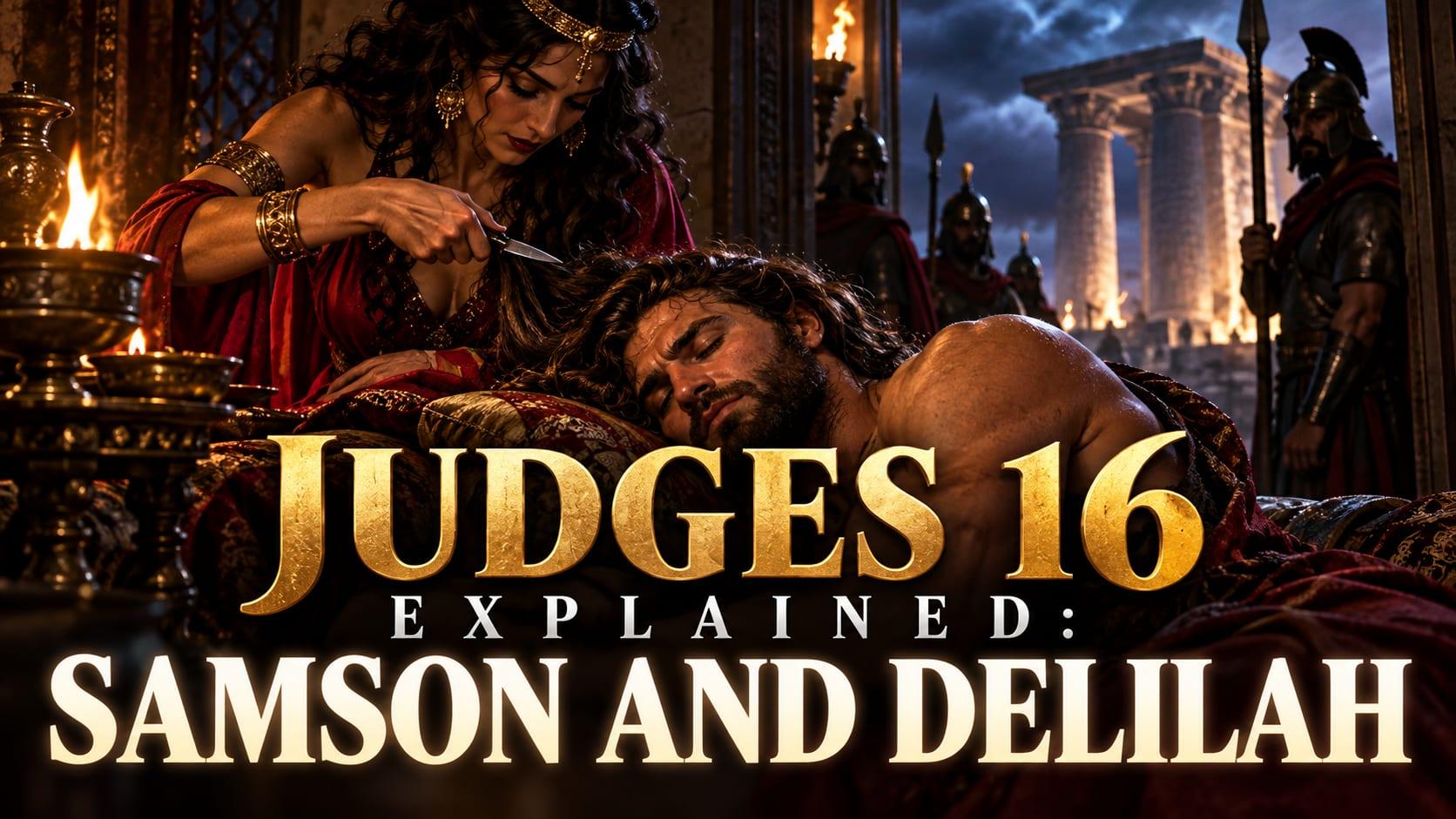
"And she made him sleep upon her knees; and she called for a man, and she caused him to shave off the seven locks of his head; and she began to afflict him, and his strength went from him."
💡 The lords bring their payment in hand this time, certain it is finally real. Someone else does the actual shaving while Samson sleeps, unaware, on the lap of the woman he loved.
"And she said, The Philistines be upon thee, Samson. And he awoke out of his sleep, and said, I will go out as at other times before, and shake myself. And he wist not that the LORD was departed from him."
📌 "Wist" is an old word for knew, and this verse is the real turning point of the chapter, not the haircut itself. Samson wakes up confident he can shake himself free like every other time. He cannot, and the text is careful to say exactly why. The strength never lived in the hair as some kind of magic. It lived in the LORD being with him, and the LORD had already gone before Samson even opened his eyes.
"But the Philistines took him, and put out his eyes, and brought him down to Gaza, and bound him with fetters of brass; and he did grind in the prison house."
⚠️ The man who once walked out of Gaza carrying its gate on his shoulders is dragged back into Gaza blind and chained. Grinding grain by hand was work usually left to a slave or an animal. Everything about this verse reverses the opening scene of this same chapter.
"Howbeit the hair of his head began to grow again after he was shaven."
💡 Easy to read past in one line. Nobody in the story seems to be watching for it, and nothing dramatic happens yet. The sign of the vow is quietly returning while Samson sits forgotten in the dark.

6. Dagon's Temple and One Last Prayer (verses 23 to 31)
Time passes, and the Philistines decide Samson's capture deserves a public celebration.
"Then the lords of the Philistines gathered them together for to offer a great sacrifice unto Dagon their god, and to rejoice: for they said, Our god hath delivered Samson our enemy into our hand."
"And when the people saw him, they praised their god: for they said, Our god hath delivered into our hands our enemy, and the destroyer of our country, which slew many of us."
💡 Dagon gets the credit for something silver and a woman's daily pressure actually did. The text lets the Philistines' praise stand uncorrected in the moment, which only makes the ending land harder.
"And it came to pass, when their hearts were merry, that they said, Call for Samson, that he may make us sport. And they called for Samson out of the prison house; and he made them sport: and they set him between the pillars."
"And Samson said unto the lad that held him by the hand, Suffer me that I may feel the pillars whereupon the house standeth, that I may lean upon them."
"Now the house was full of men and women; and all the lords of the Philistines were there; and there were upon the roof about three thousand men and women, that beheld while Samson made sport."
📌 Blind and led by a boy's hand, Samson has to ask to be shown where the pillars are. The text does not spell out exactly what "sport" involved, so any specific picture of it beyond mockery is guesswork. What it does spell out is the crowd: the full leadership of Philistia, and about three thousand more on the roof, everyone who had anything to do with Samson's capture gathered under one roof at once.
"And Samson called unto the LORD, and said, O Lord God, remember me, I pray thee, and strengthen me, I pray thee, only this once, O God, that I may be at once avenged of the Philistines for my two eyes."
💡 Samson's own words are blunt. He is not praying for Israel. He is praying for payback for his eyes. The same personal motive that drove the burning fields of Judges 15 drives this prayer too, and God answers it anyway.
"And Samson took hold of the two middle pillars upon which the house stood, and on which it was borne up, of the one with his right hand, and of the other with his left."
"And Samson said, Let me die with the Philistines. And he bowed himself with all his might; and the house fell upon the lords, and upon all the people that were therein. So the dead which he slew at his death were more than they which he slew in his life."
📌 Samson's single greatest blow against the Philistines is also the act that kills him. Archaeologists have found Philistine temples built with exactly this kind of design, a roof carried on two central pillars close enough together for one man to reach both at once, which fits what this verse describes. The last line of the verse is almost impossible to read quickly: more people die in Samson's death than in his entire twenty years of life before it.
"Then his brethren and all the house of his father came down, and took him, and brought him up, and buried him between Zorah and Eshtaol in the buryingplace of Manoah his father. And he judged Israel twenty years."
💡 The very ground named here, between Zorah and Eshtaol, is the exact place the Spirit of the LORD first began to move Samson back in Judges 13. His story opens and closes on the same stretch of land, and it closes with his own family, not strangers, carrying him home.
Hard Questions Judges 16 Raises
Was Samson sinning by visiting a harlot in Gaza? What the text says: verse 1 records the visit without comment, the same flat, factual tone used for the rest of the chapter's hard moments. How this is read: nothing in the verse excuses or explains it. It simply continues a pattern already visible since Judges 14, a man set apart from birth repeatedly reaching for exactly what his calling asked him to leave alone.
Was Delilah's betrayal worse than his first wife's in Judges 14? What the text says: verse 5 shows Delilah offered silver with no threat recorded against her, while Judges 14:15 shows his first wife facing a threat to burn her and her father's household alive. How this is read: the text draws that contrast by what it includes and leaves out for each woman. One acted under threat of death. The other took payment. Scripture lets the difference speak for itself rather than stating a verdict on either woman directly.
Was Samson's strength really tied to his hair? What the text says: verse 20 states plainly that Samson "wist not that the LORD was departed from him," immediately after describing the haircut. How this is read: the hair was never magic in itself. It was the visible sign of the Nazarite vow, and Samson giving up the sign by telling the secret is what the chapter treats as the real failure, with the LORD's departure and the physical weakness following after it.
Does Hebrews 11 naming Samson a man of faith contradict this chapter? What the text says: Hebrews 11:32 lists Samson among Gideon, Barak, and David as examples of faith, without mentioning any of his failures. How this is read: Scripture is comfortable holding both things true at once. The New Testament credits Samson's real moments of trust in God, especially the final prayer in verse 28, without pretending the rest of his story did not happen the way Judges 13 through 16 record it.
Top Verses From Judges 16
1. Judges 16:17
"That he told her all his heart, and said unto her, There hath not come a razor upon mine head; for I have been a Nazarite unto God from my mother's womb: if I be shaven, then my strength will go from me, and I shall become weak, and be like any other man."
The secret Samson never chose for himself, handed over to the one person using it against him, after three failed attempts already warned him exactly what she was doing.
2. Judges 16:20
"And he wist not that the LORD was departed from him."
The real turning point of the chapter. Not the scissors, but the LORD quietly leaving before Samson even wakes up to find out.
3. Judges 16:22
"Howbeit the hair of his head began to grow again after he was shaven."
One quiet sentence, easy to miss, that changes everything about how the rest of the chapter is allowed to end.
4. Judges 16:28
"And Samson called unto the LORD, and said, O Lord God, remember me, I pray thee, and strengthen me, I pray thee, only this once, O God, that I may be at once avenged of the Philistines for my two eyes."
A blind, humiliated man still knows exactly who to call on, even with a personal motive the prayer never bothers to hide.
5. Judges 16:30
"And Samson said, Let me die with the Philistines. And he bowed himself with all his might; and the house fell upon the lords, and upon all the people that were therein. So the dead which he slew at his death were more than they which he slew in his life."
Samson's greatest victory and his death arrive in the same breath, a line the whole book of Judges never quite matches again.
Frequently Asked Questions About Judges 16
What happened in Judges 16?
Samson visited a harlot in Gaza and escaped an ambush by carrying off the city gate. He then fell in love with Delilah, who was bribed by the Philistine lords to learn the secret of his strength. She tried three times with false answers he gave her, then wore him down until he told her the truth about his Nazarite vow. The Philistines shaved his head, captured him, and put out his eyes. Blind and imprisoned, his hair slowly grew back, and he was eventually brought out to entertain a crowd at a feast for the god Dagon, where he pulled down the temple pillars, killing himself along with the Philistine leadership.
Who was Delilah?
Verse 4 identifies her only as a woman Samson loved from the valley of Sorek, a region near Philistine territory. The text never explicitly calls her a Philistine, but the Philistine lords approach her directly to enlist her help, and she takes payment from them without hesitation.
What was the real secret of Samson's strength?
His uncut hair was the visible sign of his lifelong Nazarite vow, not a magic source of power on its own. Verse 20 says his strength failed because the LORD had departed from him, right after the haircut broke the vow he had carried since before birth.
Why did Samson finally tell Delilah the truth?
Verse 16 says she pressed him daily with her words until his soul was vexed unto death, the same kind of emotional pressure his first wife used on him in Judges 14. After three false answers protected him, the fourth round of pressure finally broke through.
What does "he wist not that the LORD was departed from him" mean?
"Wist" is an old English word for knew. Samson wakes up assuming he can break free the way he always has, unaware that his strength is already gone because the LORD's presence, not his hair itself, had already left him.
How did Samson die?
Blind and brought out to entertain a crowd at a Philistine feast, Samson asked to be positioned between the two central pillars holding up the temple of Dagon. He prayed for strength one final time, pushed the pillars apart, and the building collapsed on himself and everyone inside.
How many Philistines died when the temple collapsed?
The text does not give an exact number, only that all the Philistine lords and everyone in the house died, along with about three thousand more watching from the roof. Verse 30 states that more people died in Samson's death than in the rest of his life combined.
Why didn't God restore Samson's eyesight along with his strength?
The text never addresses this directly. It only records that God answered his specific prayer for strength to be avenged on the Philistines, not a prayer for healing, and Samson is never described as asking for his sight back.
Is Samson really listed as a hero of faith in the New Testament?
Yes. Hebrews 11:32 names Samson alongside Gideon, Barak, and David as an example of faith, without mentioning his failures. Scripture can credit a real moment of trust in God, like the prayer in verse 28, without erasing the rest of what happened in his story.
Where was Samson buried?
Verse 31 says his brothers and his father's household carried him to the burying place of his father Manoah, between Zorah and Eshtaol, the same stretch of land where the Spirit of the LORD first began moving him back in Judges 13.
Final Thoughts
Judges 16 is hard to read quickly, because the ending refuses to be simple.
📌 The haircut was never the real danger. Losing track of when the LORD had left him was. Samson woke up confident in a strength that was already gone, because he had stopped noticing the difference between his own power and God's presence long before Delilah ever called for a razor.
📌 God did not wait for Samson to clean himself up before answering his last prayer. The hair had only begun to grow back. The prayer was still about personal revenge. God strengthened him anyway, in the middle of the mess his own choices built.
📌 A life can be remembered for its worst chapter and its best moment at the same time. Judges 16 holds both without flinching, and Hebrews 11 still calls him a man of faith.
So here is your one next step.
Ask yourself what has quietly grown back in your own life after a failure, the way Samson's hair did in verse 22, and whether you are paying attention to it the way he nearly did not.