📖 Judges 15 Explained: Foxes, a Jawbone, and a Cycle of Revenge
A father gives his daughter to another man while her husband is away, and calls it a kindness.
Judges 15 explained is the chapter where that one broken marriage from the chapter before stops staying contained to one house. Samson comes back for the wife he still thinks is his, finds out she belongs to someone else now, and answers with fire. The fire does not stay his problem either. It spreads to a whole harvest, costs two people their lives, and nearly turns his own tribe against him before the twentieth verse arrives.
Maybe you have watched one unresolved hurt grow past its original size until people who had nothing to do with it ended up paying for it too.
- ❓ Why does Samson burn an entire season's crops over one broken marriage?
- ❓ Who actually carries the blame when his wife and her father are killed?
- ❓ Why do three thousand of Samson's own countrymen show up to tie him up, not to fight beside him?
- ❓ How does a dead donkey's jawbone become a weapon that kills a thousand men?
📌 Judges 15 is proof that revenge almost never stays the size of the wrong that started it.
This walkthrough goes through the whole chapter in order: the sister offered in his wife's place, the three hundred foxes, the burning fields, the burning woman, Samson's vow of payback, Judah handing its own deliverer over to the enemy rather than fight for him, the jawbone, and the spring that kept him alive at the end of it all.
Twenty verses, one match lit after another, and a man who keeps calling the fire someone else's fault.
What Happened Just Before This Chapter
Judges 14 ended mid air. Samson walked out of his own wedding feast furious after losing a riddle wager he rigged himself, and the chapter closed with one quiet, brutal sentence: his bride was given to the groomsman who had stood beside him the whole week. Nobody called it off officially. Samson simply left, and her father treated that as an answer.
Judges 15 explained picks up some time later, when Samson comes back expecting a marriage that, as far as her father is concerned, ended the night Samson walked away from it.

Judges 15 Explained Verse by Verse
1. A Sister Offered in Her Place (verses 1 to 3)
Weeks pass. Samson shows up at harvest time expecting to resume his marriage like nothing happened.
"But it came to pass within a while after, in the time of wheat harvest, that Samson visited his wife with a kid; and he said, I will go in to my wife into the chamber. But her father would not suffer him to go in."
💡 A young goat was a normal gift for visiting a wife, the kind of small gesture that assumes everything between you is still fine. Her father blocks the door before Samson gets past the threshold.
His reasoning is not spite. From where he is standing, it is simple logic.
"And her father said, I verily thought that thou hadst utterly hated her; therefore I gave her to thy companion: is not her younger sister fairer than she? take her, I pray thee, instead of her."
📌 Her father is not inventing a betrayal. Samson left angry and never came back to say otherwise, so the father read silence as a verdict. Offering the younger sister as a substitute treats one daughter as interchangeable with another, which says something ugly about how the father views both of them, but it is not framed in the text as an unreasonable response to what he actually witnessed.
"And Samson said concerning them, Now shall I be more blameless than the Philistines, though I do them a displeasure."
⚠️ Notice what Samson decides before he has done anything yet. He is already building the excuse for whatever comes next, measuring his coming revenge against how badly the Philistines have treated him, as if their wrong sets no limit on the size of his answer.
2. Three Hundred Foxes and a Field on Fire (verses 4 to 6)
Samson's answer is not aimed at the father who wronged him. It is aimed at everyone around him.
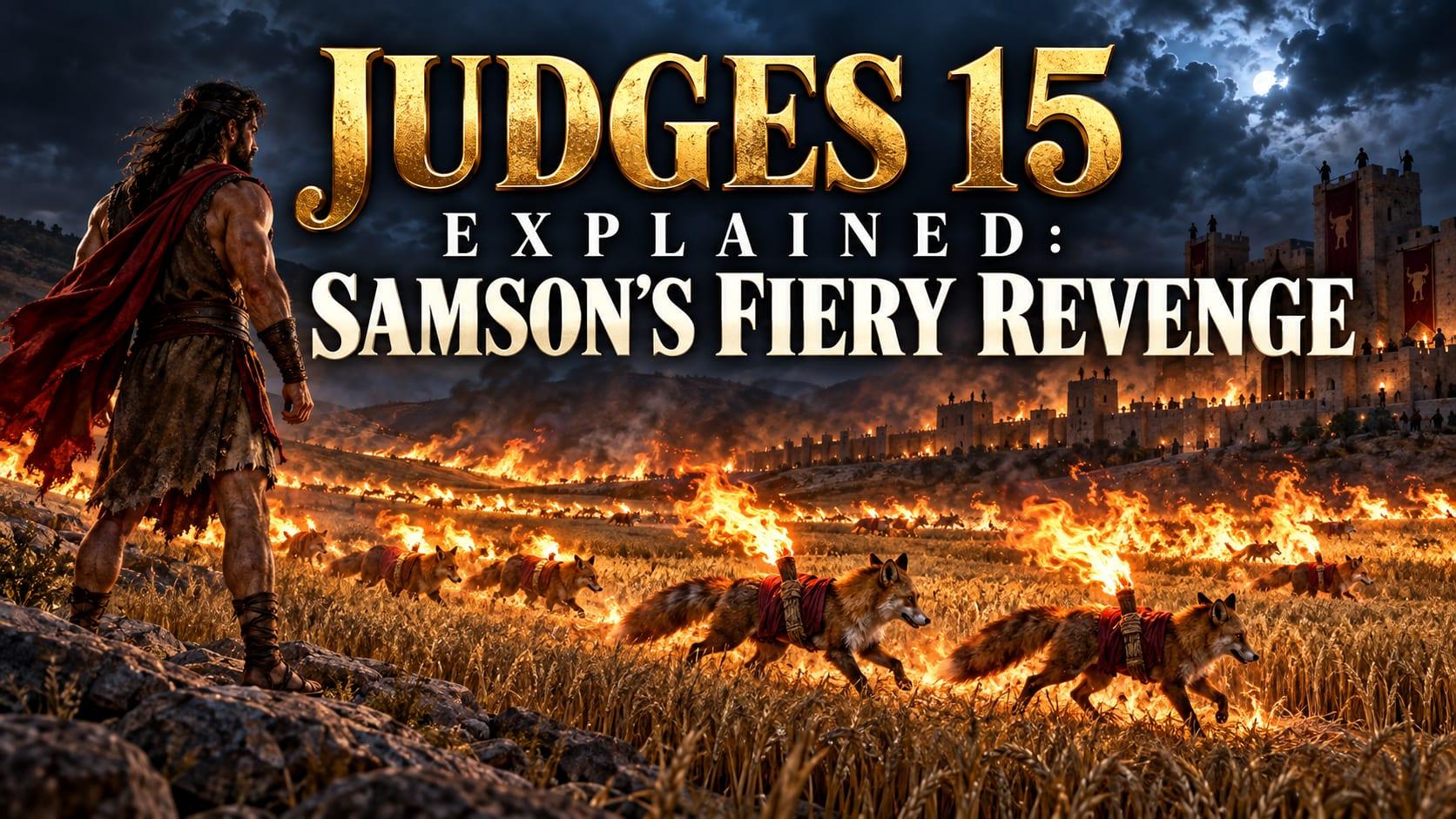
"And Samson went and caught three hundred foxes, and took firebrands, and turned tail to tail, and put a firebrand in the midst between two tails."
"And when he had set the brands on fire, he let them go into the standing corn of the Philistines, and burnt up both the shocks, and also the standing corn, with the vineyards and olives."
💡 This happens at wheat harvest, the one time of year a whole district's food for the coming year is sitting in the field. Grain, vineyards, and olive groves all go up together. Samson does not burn one man's property. He wipes out a season's income for everyone living near Timnath, Philistine families who never arranged his marriage or broke his trust.
"Then the Philistines said, Who hath done this? And they answered, Samson, the son in law of the Timnite, because he had taken his wife, and given her to his companion. And the Philistines came up, and burnt her and her father with fire."
⚠️ The Philistines answer fire with fire, and burn the two people actually responsible for the broken marriage. It is the exact threat thirty Philistine men made against Samson's wife in Judges 14, carried out for real this time, by her own people, against her and her father. The woman who was coerced into betraying Samson's secret last chapter is killed by the side she betrayed him for.

3. "I Will Cease", and a Vow That Never Does (verses 7 and 8)
Two people are dead because of a fire Samson started, and his response is to escalate again.
"And Samson said unto them, Though ye have done this, yet will I be avenged of you, and after that I will cease."
💡 "After that I will cease" sounds like a man promising himself a stopping point. Read the rest of the chapter and he never actually reaches one. One act of vengeance keeps producing the next.
"And he smote them hip and thigh with a great slaughter: and he went down and dwelt in the top of the rock Etam."
📌 "Hip and thigh" is an idiom for a total, crushing defeat, not a description of how the fighting was carried out. After the slaughter, Samson does not go home. He retreats to a natural stronghold at Etam, a man now hiding from the very people he just attacked, with a body count rising on both sides and no one yet calling for peace.
4. Judah Hands Over Its Own Deliverer (verses 9 to 13)
The conflict stops being Samson's alone the moment the Philistines decide to make his whole tribe pay for it.
"Then the Philistines went up, and pitched in Judah, and spread themselves in Lehi."
"Then three thousand men of Judah went to the top of the rock Etam, and said to Samson, Knowest thou not that the Philistines are rulers over us? what is this that thou hast done unto us? And he said unto them, As they did unto me, so have I done unto them."
⚠️ Three thousand men of Judah come looking for Samson, and not one of them comes to fight beside him. Their question is not "how do we beat the Philistines". It is "why did you stir this up and put the rest of us at risk". After generations of living under foreign rule, peace with the oppressor feels safer to them than war for a deliverer they never asked for. Samson's own answer, "as they did unto me, so have I done unto them", states the chapter's whole logic of matched payback in one line, the same measure for measure standard Scripture later limits carefully in laws like the one behind Leviticus 24. Nothing about this chapter suggests Samson is keeping to that limit.
"And they said unto him, We are come down to bind thee, that we may deliver thee into the hand of the Philistines. And Samson said unto them, Swear unto me, that ye will not fall upon me yourselves."
"And they spake unto him, saying, No; but we will bind thee fast, and deliver thee into their hand: but surely we will not kill thee. And they bound him with two new cords, and brought him up from the rock."
💡 Samson does not resist three thousand of his own people tying him up. He only asks for one guarantee, that they will not kill him themselves, and lets them hand him to the Philistines instead. Whatever else is happening in him, it is not fear of his own countrymen.

5. The Jawbone of an Ass (verses 14 to 17)
Bound, surrounded, and handed over by his own tribe, Samson is as helpless as he has been in the story so far. Then everything changes in one verse.
"And when he came unto Lehi, the Philistines shouted against him: and the Spirit of the LORD came mightily upon him, and the cords that were upon his arms became as flax that was burnt with fire, and his bands loosed from off his hands."
📌 The same Spirit that moved Samson before he was even grown, back when he was still only beginning to deliver Israel in Judges 13, now comes on him as a captive with no weapon and no allies. New cords, strong enough to bind a grown man, snap like thread the instant the Spirit comes mightily on him. Every human effort to contain him in this chapter, his father-in-law's decision, Judah's rope, fails the same way.
"And he found a new jawbone of an ass, and put forth his hand, and took it, and slew a thousand men therewith."
💡 "New" here means freshly dead, not old and dried out, which is exactly why the bone is still solid enough to use as a club rather than crumbling in his hand. Samson is unarmed in every ordinary sense and still turns the battlefield itself into a weapon.
"And Samson said, With the jawbone of an ass, heaps upon heaps, with the jaw of an ass have I slain a thousand men."
"And it came to pass, when he had made an end of speaking, that he cast away the jawbone out of his hand, and called that place Ramathlehi."
📌 Ramathlehi means "the hill of the jawbone", and Samson names it himself, in a line he composes about his own victory. He is already narrating his own legend while the bodies are still on the ground, the same instinct that turned a dead lion into a riddle one chapter earlier.
6. Thirst, a Prayer, and a Spring Called "The One Who Cried" (verses 18 to 20)
Right after the biggest display of raw strength in the chapter, Samson hits a limit strength cannot solve.
"And he was sore athirst, and called on the LORD, and said, Thou hast given this great deliverance into the hand of thy servant: and now shall I die for thirst, and fall into the hand of the uncircumcised?"
💡 This is the first time in his whole story that Samson is recorded actually praying, asking God for something rather than simply being used by the Spirit. Killing a thousand men did not make him thirsty. Not drinking is what might finish him off after the enemy already failed to.
"But God clave an hollow place that was in the jaw, and there came water thereout; and when he had drunk, his spirit came again, and he revived: wherefore he called the name thereof Enhakkore, which is in Lehi unto this day."
📌 En-hakkore means "the spring of him that called", named for the prayer that opened it rather than for the strength that won the battle just before it. God answers a desperate, honest request in the middle of a mess Samson largely created himself, which is a different thing than approving the chain of fire and death that got him there.
"And he judged Israel in the days of the Philistines twenty years."
💡 The chapter closes with a summary line usually saved for the very end of a judge's story, even though Samson's account keeps going for six more chapters. Everything after this point happens inside the span this verse has already measured out.

Hard Questions Judges 15 Raises
Was burning the Philistines' fields justice or personal revenge? What the text says: verse 3 has Samson decide in advance that he will be no more guilty than the Philistines no matter what he does to them, and verse 7 frames the fire and the slaughter that follow as being avenged, not as a rescue of Israel. How this is read: unlike the lion in the chapter before, the text never credits this specific act to the Spirit of the LORD. It reads as a man answering a personal wound on his own terms, using the size of his enemy's guilt to excuse an answer that outgrows the original wrong by a wide margin.
Who is actually responsible for the deaths of Samson's wife and her father? What the text says: verse 6 states plainly that the Philistines burned them, in direct retaliation for Samson's fire. How this is read: the chapter does not pin the deaths on a single cause. Her father set the chain moving by giving her away. Samson escalated it by destroying a season's harvest. Philistine neighbors carried out the actual killing. Three separate choices combine into an outcome worse than any one of them intended on its own.
Why did three thousand men of Judah hand their own deliverer over to the enemy? What the text says: verse 11 has them confront Samson directly, reminding him the Philistines rule over them, before agreeing in verse 13 to bind him rather than fight. How this is read: after generations under foreign rule, keeping an uneasy peace felt safer to them than standing behind the one man raised up to end it. The same instinct to avoid cost rather than pursue real deliverance shows up repeatedly across this book whenever Israel settles for survival instead of victory.
Does God answering Samson's prayer mean He approved of everything leading up to it? What the text says: verse 18 records Samson's first personal prayer in his whole story, and verse 19 has God provide water immediately in response. How this is read: Scripture regularly shows God meeting an honest, desperate request in the middle of a situation someone largely created through their own choices. Providing water answers Samson's thirst. It does not function in the text as a verdict on the fire, the broken vow, or the bodies already left behind by the time he prays.
Top Verses From Judges 15
1. Judges 15:11
"Knowest thou not that the Philistines are rulers over us? what is this that thou hast done unto us? And he said unto them, As they did unto me, so have I done unto them."
The whole chapter's logic in one sentence: matched payback, with no built in limit on where it stops.
2. Judges 15:14
"And the Spirit of the LORD came mightily upon him, and the cords that were upon his arms became as flax that was burnt with fire, and his bands loosed from off his hands."
A bound, defenseless man becomes unstoppable in a single verse, the moment the Spirit of the LORD comes on him.
3. Judges 15:16
"And Samson said, With the jawbone of an ass, heaps upon heaps, with the jaw of an ass have I slain a thousand men."
Samson turning his own victory into a line worth remembering, the same instinct that made a riddle out of the lion one chapter earlier.
4. Judges 15:18
"And he was sore athirst, and called on the LORD, and said, Thou hast given this great deliverance into the hand of thy servant: and now shall I die for thirst, and fall into the hand of the uncircumcised?"
The strongest moment in the chapter is followed immediately by the most honest one: a man who finally admits he needs help.
5. Judges 15:19
"But God clave an hollow place that was in the jaw, and there came water thereout; and when he had drunk, his spirit came again, and he revived: wherefore he called the name thereof Enhakkore, which is in Lehi unto this day."
A spring named for a prayer, not for the battle that came right before it.
Frequently Asked Questions About Judges 15
What happened in Judges 15?
Samson returned for his wife and learned her father had given her to another man, offering her younger sister instead. In response Samson burned the Philistines' fields using three hundred foxes with firebrands tied to their tails. The Philistines retaliated by burning Samson's wife and her father to death. Samson swore revenge and killed many Philistines, then three thousand men of Judah bound him and handed him over to the Philistines to avoid wider conflict. The Spirit of the LORD broke his bonds, and he killed a thousand men with a donkey's jawbone. Afterward, dying of thirst, he prayed, and God opened a spring to save his life. The chapter closes noting he judged Israel twenty years.
Why did Samson burn the Philistines' fields with foxes?
After learning his wife had been given to someone else, Samson caught three hundred foxes, tied firebrands between their tails in pairs, and released them into the standing grain, destroying the crops, vineyards, and olive groves at harvest time as an act of revenge against the Philistines who wronged him.
Who killed Samson's wife and her father?
Verse 6 says the Philistines themselves burned her and her father to death, in retaliation for Samson destroying their harvest, once they learned he was the one responsible for the fire.
Why did the men of Judah hand Samson over to the Philistines?
Three thousand men of Judah came to Samson after the Philistines invaded their territory looking for him. Living under Philistine rule already, they chose to bind him and deliver him to the enemy rather than risk a wider war on his behalf, though they did make him swear they would not kill him themselves.
What does "smote them hip and thigh" mean?
It is a Hebrew idiom for a complete, crushing defeat rather than a literal description of how the fighting happened. Verse 8 uses it to summarize a decisive slaughter of Philistines after they burned Samson's wife and her father.
How did Samson kill a thousand men with a jawbone?
After the Spirit of the LORD broke the cords binding him, Samson found a freshly dead donkey's jawbone still solid enough to use as a weapon and killed a thousand Philistine men with it at a place he then named Ramathlehi, meaning the hill of the jawbone.
What does En-hakkore mean?
En-hakkore means the spring of him that called. Samson named it after God opened a hollow place in the ground to provide water in answer to his prayer when he was close to dying of thirst following the battle at Lehi.
Why does Judges 15:20 say Samson judged Israel for twenty years in the middle of his story?
Verse 20 gives a summary statement of Samson's whole length of service as judge, even though his story continues for several more chapters. This kind of summary line usually closes out a judge's account in this book, but here it marks the end of this particular conflict rather than the end of Samson's life.
Was Samson right to take revenge on the Philistines?
The chapter never states a direct verdict. Samson frames his actions as fair payback in verse 3 and verse 11, but the text also shows the damage reaching far past the people who actually wronged him, destroying a harvest and leading to deaths on both sides that outgrow the original broken marriage.
Final Thoughts
Judges 15 moves fast, and almost every move in it makes the next one bigger.
📌 Revenge rarely stays the size of the wrong that started it. One broken marriage ends with a burned harvest, two burned bodies, a captured judge, and a thousand dead men, and Samson still has not reached the "ceasing" he promised in verse 7.
📌 Self-preservation can look exactly like betrayal to the person counting on you. Judah's three thousand men were not traitors by their own accounting. They were simply unwilling to pay the cost of standing behind their own deliverer.
📌 God can meet an honest prayer in the middle of a mess someone made themselves. En-hakkore is named for Samson's cry for help, not for his victory, and it comes right after the one moment in the chapter he stops relying only on his own strength.
So here is your one next step.
Name one place where you are tempted to answer a wrong with something bigger than the wrong itself, and stop there instead of letting it grow another match.