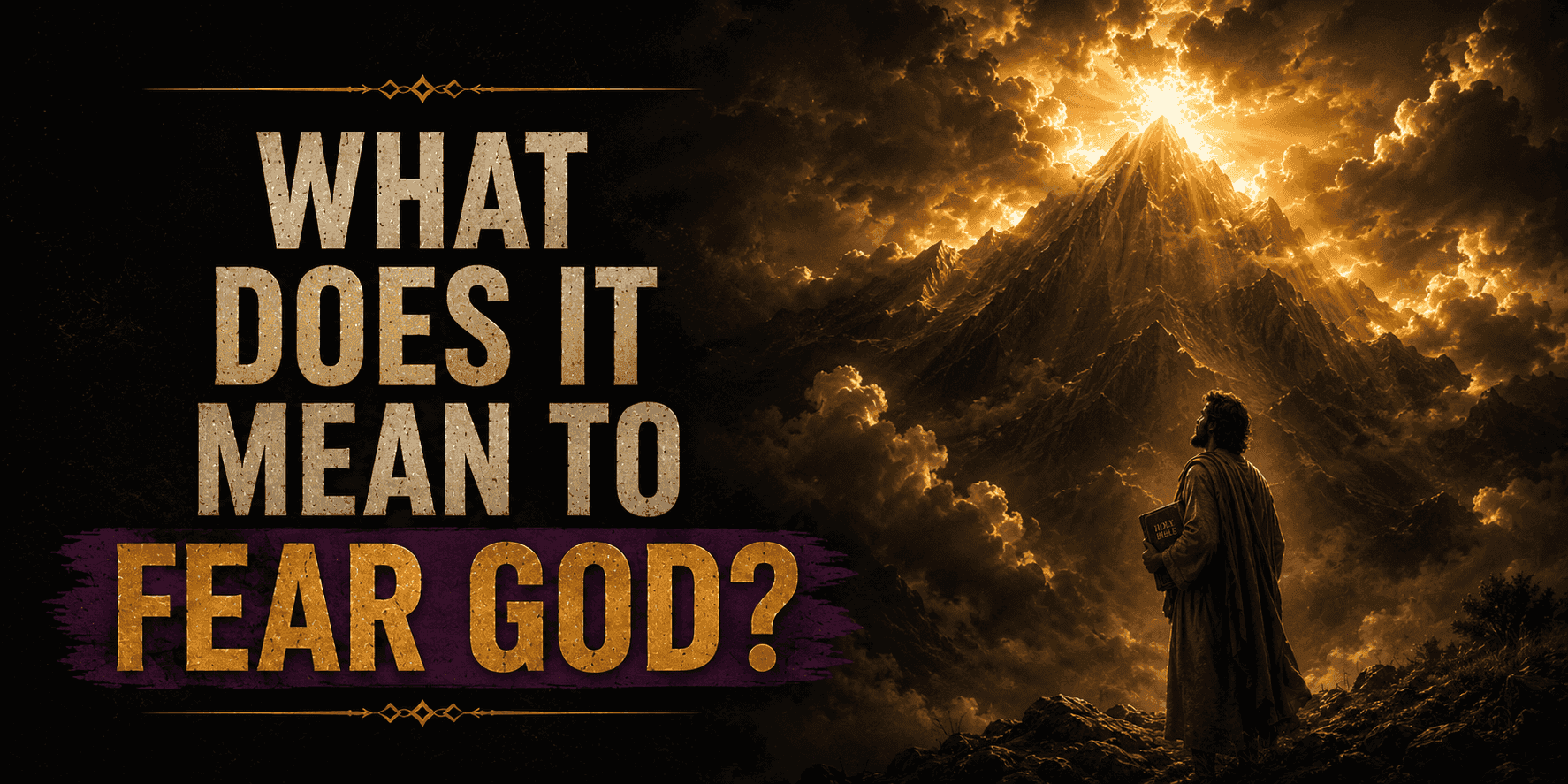
📖 What Does It Mean to Fear God? A Clear Answer for Christians
Somewhere in your Bible reading you hit the phrase "fear God."
And it stopped you.
Because a few chapters earlier you read that God is love.
So which one is true?
📌 Here is the honest answer before we go any further. The fear of the Lord is not terror of a cruel God, and it is not just ordinary respect either. It is something bigger than both.
It is the reverent awe of someone who has actually understood who God is.
- 🔲 Not hiding from an angry God
- 🔲 Not flinching every time you pray
- 🔲 Not polite distance toward a ruler you barely know
Maybe you grew up hearing "fear God" preached like a threat.
Or maybe you have never heard anyone explain it at all. Just repeat it.
Here is what might surprise you.
The fear of the Lord is not the opposite of loving Him.
📖 Scripture calls it the beginning of wisdom.
And some of the godliest people in the Bible, people who walked closest with God, are the very ones who ended up on the ground in front of Him.
Here is what this guide will walk you through.
- ✅ What the fear of the Lord actually means
- ✅ Why Isaiah fell apart the moment he saw God clearly
- ✅ Why the disciples got more afraid after Jesus calmed the storm, not less
- ✅ How fearing God and loving God fit together without a contradiction
This is not a guide that talks you out of the question.
It takes the phrase seriously, the way Scripture does.
Let's find out what it actually means to fear God.
Why This Matters for Your Faith
You could skip this whole topic and still love Jesus.
So why does it matter?
Because what you believe about the fear of the Lord shapes the God you actually pray to.
Get it wrong one way, and God becomes a threat you manage. You keep your distance.
Get it wrong the other way, and God becomes a friend with no weight to Him. You stop listening.
Both of those are smaller than the God of the Bible. Both of them will quietly change how you worship, how you obey, and how seriously you take His Word.
Louis has written before on what the Bible says about fear in general, the kind that keeps you up at night. This one is different.
📌 This is not fear of losing your job, your health, or your safety. This is fear of the Lord Himself. The right kind, pointed at the right person.
Get this one right, and something changes.
You stop treating God like a vending machine and start treating Him like God.

What the Fear of the Lord Actually Means
1. It Is Not Terror of a God Waiting to Strike You
Start with what it is not.
Some people picture God the way they would picture an unpredictable boss.
Nervous around Him. Waiting for the moment they mess up.
⚠️ That picture is not the fear of the Lord. That is dread.
Dread keeps you away from God. It makes you want to hide, the same way Adam hid in the garden the moment he knew he had done wrong.
The fear of the Lord does the opposite.
💡 It draws you closer to God, not further away.
It is not the fear of a child hiding from an abusive parent. It is the fear of a child who finally understands how big, how holy, and how good their Father really is.
2. It Is Not Just Everyday Respect Either
So if it is not terror, is it just respect? The same respect you give a boss or a teacher?
Not quite.
Respect for a person can stay comfortable. It rarely rearranges your life.
Solomon described something heavier:
"The fear of the LORD is to hate evil: pride, and arrogancy, and the evil way, and the froward mouth, do I hate."
Notice what that fear produces. Not nervousness. A hatred of evil.
You can respect your boss and still cut corners when nobody is watching.
You cannot truly fear the Lord and treat sin as casual.
📌 The fear of the Lord changes what you are willing to live with. Ordinary respect rarely does.
3. It Is the Beginning of Wisdom
Scripture does not leave you guessing where wisdom actually starts.
"The fear of the LORD is the beginning of wisdom: and the knowledge of the holy is understanding."
Not the end of wisdom. The beginning. Everything you will ever learn about God starts from this one posture.
Job says almost the exact same thing, from the other end of a lifetime of suffering:
"And unto man he said, Behold, the fear of the LORD, that is wisdom; and to depart from evil is understanding."
Two different writers, generations apart, land on the same truth. You cannot be wise about God while you are casual toward Him.
It is why Proverbs 9 opens with Wisdom building a house and sending out invitations. She assumes the listener already fears the Lord enough to accept one.
Skip this first step, and nothing else in the Christian life quite lines up right.
4. Isaiah Saw Who God Really Is
If you want to see reverent fear up close, watch what happens to a prophet.
Isaiah was already a godly man. He had already been preaching for God.
Then he actually saw the throne room:
"In the year that king Uzziah died I saw also the LORD sitting upon a throne, high and lifted up, and his train filled the temple. Above it stood the seraphims: each one had six wings; with twain he covered his face, and with twain he covered his feet, and with twain he did fly. And one cried unto another, and said, Holy, holy, holy, is the LORD of hosts: the whole earth is full of his glory."
Notice the seraphim cover their own faces in front of Him.
And notice Isaiah's reaction was not pride at the privilege. It was this:
"Then said I, Woe is me! for I am undone; because I am a man of unclean lips, and I dwell in the midst of a people of unclean lips: for mine eyes have seen the King, the LORD of hosts."
Undone. That is the word for a man who finally saw the real size of God and the real size of his own sin at the same time.
📌 The closer you get to who God actually is, the less casual you become. Every single time.

5. The Disciples Were More Afraid After the Storm Than During It
Here is a detail that surprises most people the first time they notice it.
A storm hit the lake. The disciples were terrified, so they woke Jesus up. He stood, spoke one word, and the water went flat.
Read their reaction to that:
"And they came to him, and awoke him, saying, Master, master, we perish. Then he arose, and rebuked the wind and the raging of the water: and they ceased, and there was a calm. And he said unto them, Where is your faith? And they being afraid wondered, saying one to another, What manner of man is this! for he commandeth even the winds and water, and they obey him."
Read that again. They were afraid of the storm. Then the storm ended, and they got more afraid.
❓ Why would calm water scare them more than waves that could drown them?
Because the storm was a danger they understood. The man who could silence it with one sentence was something else entirely.
They had just seen, up close, that the person in the boat with them was God.
That is reverent fear. Not fear of the danger. Fear of being near the One who rules it.
6. Fear of God and Love for God Are Not Opposites
Now back to the question that opened this guide. How does "fear God" sit next to "God is love"?
Moses already answered this, long before John ever wrote that God is love:
"And now, Israel, what doth the LORD thy God require of thee, but to fear the LORD thy God, to walk in all his ways, and to love him, and to serve the LORD thy God with all thy heart and with all thy soul, to keep the commandments of the LORD, and his statutes, which I command thee this day for thy good?"
Fear and love sit in the very same sentence. Moses never treats them as rivals.
John clears up which fear gets cast out by love:
"There is no fear in love; but perfect love casteth out fear: because fear hath torment. He that feareth is not made perfect in love."
John is talking about torment. The fear of a God you cannot trust, who might reject you no matter what you do. That fear gets cast out, because perfect love settles it for good.
Reverent fear is different. It is not afraid of being rejected by God. It is in awe of being loved by Him anyway.
Reading who God is as a Father helps here. A good father can be someone a child deeply reveres and deeply trusts at the exact same time. Those two never had to compete.
7. What Reverent Fear Produces in a Life
Fear of the Lord is not a feeling you work up once and move on from.
It is a posture that keeps producing fruit over a lifetime.
"Wherefore we receiving a kingdom which cannot be moved, let us have grace, whereby we may serve God acceptably with reverence and godly fear: For our God is a consuming fire."
Notice the word serve. Reverent fear does not freeze you. It moves you to obedience.
Luke records the early church walking in exactly that rhythm:
"Then had the churches rest throughout all Judaea and Galilee and Samaria, and were edified; and walking in the fear of the Lord, and in the comfort of the Holy Ghost, were multiplied."
Read that carefully. Fear of the Lord and comfort of the Holy Spirit, growing in the same church, at the same time.
💡 That is the proof that this fear is healthy. It never crushes a church. It grows one.

Practical Tips: How to Grow in the Fear of the Lord
Reverent fear is not something you force in an afternoon.
It grows the same way any relationship with someone great does. Slowly, with attention.
Here are seven ways to start this week.
- Let a Psalm about God's greatness come before your requests. Read Psalm 29 or Psalm 93 before you ask God for anything today. Let your mind settle on who He is before you bring Him your list.
- Name who you are talking to before you pray. Say it out loud if you need to. "Lord of heaven and earth, I am talking to You." It changes the whole tone of the prayer that follows.
- Stop editing God down to fit your comfort. If a passage about His holiness or His judgment makes you uneasy, sit with the discomfort instead of explaining it away.
- Obey the part you already understand. Reverence is proven in obedience, not in feelings. Pick one command you have been avoiding and keep it this week.
- Remove the sin you have gotten casual about. Proverbs 8:13 ties the fear of the Lord straight to hating evil. If something no longer bothers your conscience, ask God to restore that alarm.
- Study who God is, not just what He can give you. Spend time in His attributes: His holiness, His justice, His mercy. A small view of God always produces a small fear of Him.
- Bring reverence into ordinary moments. Not only in church on Sunday. At your desk, in traffic, folding laundry. He is the same God in all of it.
Pick one of these. Not all seven at once.
A reverent life is built one honest habit at a time.
Top 5 Bible Verses About the Fear of the Lord
If you want a short list to come back to, start here.
1. Proverbs 9:10
"The fear of the LORD is the beginning of wisdom: and the knowledge of the holy is understanding."
Keep this verse first, because everything else about wisdom rests on it. You cannot skip to the middle of wisdom and leave this step out.
Notice it is not called a small ingredient. It is the beginning, the foundation everything else is built on.
This is the verse for the Christian who wants to grow deeper but keeps stalling. Start here again.
2. Psalm 111:10
"The fear of the LORD is the beginning of wisdom: a good understanding have all they that do his commandments: his praise endureth for ever."
This verse adds the piece Proverbs leaves implied. Good understanding shows up in doing His commandments, not just in agreeing with them.
Reverent fear was never meant to stay in your head.
It was always meant to move your hands and your feet.
3. Deuteronomy 10:12 and 13
"And now, Israel, what doth the LORD thy God require of thee, but to fear the LORD thy God, to walk in all his ways, and to love him, and to serve the LORD thy God with all thy heart and with all thy soul, to keep the commandments of the LORD, and his statutes, which I command thee this day for thy good?"
This is the verse that settles the whole "fear or love" question in one breath. Fear, love, and obedience are listed together, not against each other.
And notice the ending. "For thy good." God never asked for reverence to make your life smaller. He asked for it because it is good for you.

4. Isaiah 6:5
"Then said I, Woe is me! for I am undone; because I am a man of unclean lips, and I dwell in the midst of a people of unclean lips: for mine eyes have seen the King, the LORD of hosts."
This is the verse for anyone who has grown too comfortable with God. Isaiah was a prophet, not a stranger to Him, and he still ended up undone.
Reverent fear has a way of showing you your own sin clearly, right alongside His holiness.
It does not stop there, though. A few verses later, the same God sends a seraph to cleanse him.
5. Hebrews 12:28 and 29
"Wherefore we receiving a kingdom which cannot be moved, let us have grace, whereby we may serve God acceptably with reverence and godly fear: For our God is a consuming fire."
This is the verse for worship itself. It ties reverence directly to how you serve God, not just how you feel about Him in a quiet moment.
A consuming fire does not politely coexist with casual approach. This is the verse to read right before you walk into church, not after you leave.
Frequently Asked Questions About Fearing God
Is fearing God the same as being afraid of Him?
Not in the way most people use the word afraid. Being afraid of someone usually means wanting to stay away from them. The fear of the Lord does the opposite. It draws you closer, the way Isaiah and the disciples both moved toward God, not away, once they saw Him clearly.
Why does the Bible say God is love but also tells us to fear Him?
Because they answer different questions. "God is love" tells you His nature toward you. "Fear the Lord" tells you the right response to how great He is. A love this big, from someone this holy, deserves more than casual affection. It deserves reverence.
What does fear of the Lord mean in Proverbs?
In Proverbs it means the starting posture for wisdom. Proverbs 9:10 calls it the beginning of wisdom, and Proverbs 8:13 ties it to hating evil. It is not a one time feeling but an ongoing respect for God that shapes your daily choices.
Is the fear of the Lord the same thing as reverence?
Reverence is a good word for it, as long as you remember how big this reverence is. Hebrews 12:28 and 29 calls God a consuming fire in the same breath it calls for reverence. This is not the mild respect you show a stranger. It is awe toward someone who could undo you and chooses instead to love you.
Why was Isaiah so afraid in Isaiah 6?
Isaiah saw God's actual holiness up close, not just heard about it. Seeing it exposed his own sin instantly. He was not afraid God would harm him. He was undone by the gap between God's holiness and his own.
Why were the disciples more afraid after Jesus calmed the storm?
Before the storm ended, they were afraid of drowning, a danger they understood. After it ended, they realized they were sitting beside someone who could command wind and water with a word. That realization, that they were in the presence of God Himself, was far more overwhelming than the waves ever were.
Does fearing God mean I cannot have a close relationship with Him?
No. Deuteronomy 10:12 lists fearing God right alongside loving Him and serving Him with your whole heart. The closest people to God in Scripture, Moses, Isaiah, the disciples, are the same ones who feared Him the most honestly. Closeness and reverence grew together in every one of them.
What is the difference between fearing God and feeling anxious?
They are opposite directions entirely. Anxiety pulls your eyes toward a problem and away from God. The fear of the Lord pulls your eyes toward God Himself. One shrinks your world down to the fear. The other grows your view of who is actually in control of it.
How do I grow in the fear of the Lord?
Slowly, and mostly through exposure. Spend real time in who God is, not only in what He gives you. Read the Psalms that describe His greatness. Obey the parts of His Word you already understand. Reverence tends to grow the same way familiarity with a great person grows, through steady attention over time.
Is the fear of the Lord the opposite of faith?
No, it is part of faith. Faith trusts who God is. The fear of the Lord takes that same God seriously enough to let Him change how you live. You cannot truly trust someone you have never taken seriously, and you cannot truly fear the Lord while refusing to trust Him.
Final Thoughts
If you remember nothing else from this guide, remember these three things.
📌 The fear of the Lord is not terror and it is not mere respect. It is the reverent awe of someone who has actually seen who God is, the way Isaiah did, the way the disciples did in that boat.
📌 Fear and love were never rivals. Moses put them in the same sentence. The closest people to God feared Him the most honestly and loved Him the most deeply, at the same time.
📌 This fear is the beginning of wisdom, not the end of comfort. It does not push you away from God. It is what finally brings you close enough to see Him clearly.
You do not need to force a feeling today.
You just need to stop shrinking God down to a size that is easy to manage.
Open a Psalm that pictures Him as He really is. Let it be bigger than you expected. Let that be where reverence starts.
He is not far off, waiting to catch you doing wrong.
He is high and lifted up, and He still wants you close.