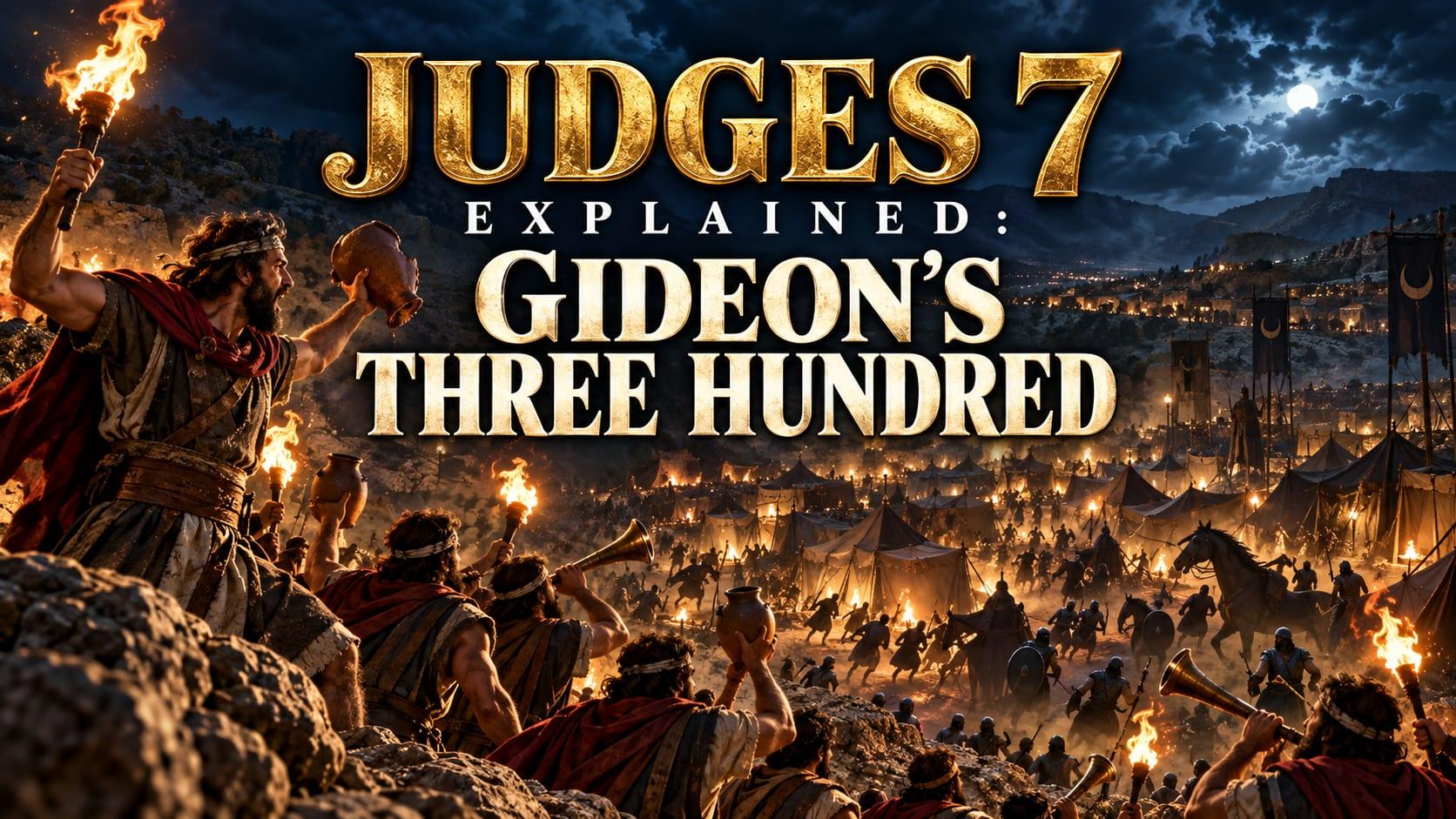
📖 Judges 7 Explained: Gideon's Three Hundred and the Midianite Rout
Thirty two thousand men show up ready to fight. By the end of the chapter, three hundred of them do all the fighting, and not one of them swings a sword.
Judges 7 explained is the chapter where Gideon's army gets smaller twice before it ever reaches the Midianite camp, first by fear, then by a strange test at the water, until the force God will use is barely one soldier out of every hundred who first answered the trumpet. Then that tiny force wins without drawing a weapon that could actually kill anyone.
Maybe you have stood at the edge of something that needed far more than you had, and watched the little you did have get smaller still.
- ❓ Why does God keep shrinking Gideon's army instead of growing it?
- ❓ What did the water test at the lapping actually measure?
- ❓ Why does a dream about a loaf of bread matter more than a battle plan?
- ❓ How do trumpets and broken jars defeat an army that outnumbers you by hundreds to one?
📌 Every cut to Gideon's army makes the coming victory harder to credit to Gideon.
This walkthrough goes through the whole chapter in order: the camp at the well of Harod, the first cut that sends twenty two thousand men home for fear, the second cut at the water that leaves only three hundred, Gideon's night visit to the enemy camp and the dream that steadies him, the trumpets and pitchers that turn three hundred men into the sound of an army, and the rout that two more tribes join only after the real fighting is already decided.
Twenty five verses, one army that keeps losing men, and a victory nobody in it could take credit for.
What Happened Just Before This Chapter
Judges 6 introduced Gideon hiding wheat from Midianite raiders, then called him through the angel of the LORD to deliver Israel. God confirmed the call with fire rising out of a rock, and Gideon built an altar there called Jehovahshalom. The same night, he tore down his own father's altar of Baal, by darkness because he feared his father's household, and was given a second name, Jerubbaal, after his father publicly dared the idol to defend itself. When Midian finally gathered for a full invasion, the Spirit of the LORD came on Gideon, and he called Abiezer, Manasseh, Asher, Zebulun, and Naphtali to muster. Before leading them anywhere, he asked God to confirm the promise twice more with a fleece of wool, and God granted both signs exactly as asked, with no rebuke either time.
Judges 7 opens with that same gathered army already camped, facing an enemy the last chapter described as without number. Nothing in the chapter break explains away the fear Gideon has shown the entire time. It simply moves forward into the fight that fear has to meet.

Judges 7 Explained Verse by Verse
1. The Camp at the Well of Harod, and the First Cut (verses 1 to 3)
The chapter opens with two camps settling into place on opposite sides of a valley.
"Then Jerubbaal, who is Gideon, and all the people that were with him, rose up early, and pitched beside the well of Harod: so that the host of the Midianites were on the north side of them, by the hill of Moreh, in the valley."
💡 The verse opens with "Jerubbaal, who is Gideon," not just Gideon. The name his own father gave him as a taunt against a lifeless idol is now the name the text uses first, right before he leads Israel into the one battle this whole book has been building toward.
Before a single arrow flies, God tells Gideon the army itself is the problem.
"And the LORD said unto Gideon, The people that are with thee are too many for me to give the Midianites into their hands, lest Israel vaunt themselves against me, saying, Mine own hand hath saved me."
"Now therefore go to, proclaim in the ears of the people, saying, Whosoever is fearful and afraid, let him return and depart early from mount Gilead. And there returned of the people twenty and two thousand; and there remained ten thousand."
📌 God is not worried Gideon has too few men to win. He is worried Gideon could have enough men to claim the credit. The command to send home anyone who is fearful echoes almost word for word the law Moses gave in Deuteronomy 20, where officers were told to release any soldier too afraid to fight before a battle ever started. Gideon is not improvising a new policy. He is applying one Israel already had.
⚠️ The numbers do the rest of the talking. Twenty two thousand men walk away, and ten thousand remain, which means the army camped at Harod started this chapter at thirty two thousand strong, against a host the previous chapter already said was without number.
2. The Second Cut, at the Water (verses 4 to 8)
Ten thousand men is still too many for what God is about to do.
"And the LORD said unto Gideon, The people are yet too many; bring them down unto the water, and I will try them for thee there: and it shall be, that of whom I say unto thee, This shall go with thee, the same shall go with thee; and of whomsoever I say unto thee, This shall not go with thee, the same shall not go."
"So he brought down the people unto the water: and the LORD said unto Gideon, Every one that lappeth of the water with his tongue, as a dog lappeth, him shalt thou set by himself; likewise every one that boweth down upon his knees to drink."
"And the number of them that lapped, putting their hand to their mouth, were three hundred men: but all the rest of the people bowed down upon their knees to drink water."
💡 The text never explains what exactly separated the three hundred from the rest. Many Bible teachers read it this way: a man who scooped water to his mouth with a cupped hand could keep his eyes up and a weapon within reach the whole time, while a man who knelt down and put his face to the stream gave his full attention to drinking and nothing else. If that reading holds, the test was never about thirst. It was about who stayed alert even at a water stop.
Whatever the water showed, God names the exact number that matters.
"And the LORD said unto Gideon, By the three hundred men that lapped will I save you, and deliver the Midianites into thine hand: and let all the other people go every man unto his place."
"So the people took victuals in their hand, and their trumpets: and he sent all the rest of Israel every man unto his tent, and retained those three hundred men: and the host of Midian was beneath him in the valley."
📌 Three hundred men out of the thirty two thousand who first mustered is under one in a hundred. God does not reduce Gideon's odds by half or by two thirds. He reduces them until almost no honest reading of the numbers could call the coming win a military achievement.

3. A Night Scout, and a Dream of Barley Bread (verses 9 to 15)
With the army down to three hundred, God speaks again that same night, and offers Gideon one more kind of help if he still needs it.
"And it came to pass the same night, that the LORD said unto him, Arise, get thee down unto the host; for I have delivered it into thine hand."
"But if thou fear to go down, go thou with Phurah thy servant down to the host: And thou shalt hear what they say; and afterward shall thine hands be strengthened to go down unto the host."
💡 God does not shame Gideon for still being afraid after everything already shown him, fire from a rock, two fleece signs, and a victory already promised in plain words. He simply offers another way to get the same confidence, by sending him to listen rather than demanding he just believe on command.
What Gideon overhears is not a battle plan. It is a dream.
"And the Midianites and the Amalekites and all the children of the east lay along in the valley like grasshoppers for multitude; and their camels were without number, as the sand by the sea side for multitude."
"And when Gideon was come, behold, there was a man that told a dream unto his fellow, and said, Behold, I dreamed a dream, and, lo, a cake of barley bread tumbled into the host of Midian, and came unto a tent, and smote it that it fell, and overturned it, that the tent lay along."
"And his fellow answered and said, This is nothing else save the sword of Gideon the son of Joash, a man of Israel: for into his hand hath God delivered Midian, and all the host."
⚠️ Barley bread was the cheapest, roughest grain a poor farmer baked, nothing close to what a soldier would picture as a weapon. In the dream, that loaf still flattens a tent belonging to an army too large to count. The Midianite soldier who hears it does not debate what it means. He names Gideon by name, inside the enemy camp, before Gideon has done anything but stand there listening.
Gideon's response to overhearing his own name is not relief alone.
"And it was so, when Gideon heard the telling of the dream, and the interpretation thereof, that he worshipped, and returned into the host of Israel, and said, Arise; for the LORD hath delivered into your hand the host of Midian."
📌 Gideon worships before he commands. The same man who once asked for fire from a rock and a fleece soaked in dew now has his answer from the mouth of an enemy soldier who never knew he was being overheard, and his first move is not to plan the attack but to bow down.
4. Trumpets, Pitchers, and a Cry That Was Not a Weapon (verses 16 to 22)
Gideon arms his three hundred men, and nothing he hands them is built to kill anyone.
"And he divided the three hundred men into three companies, and he put a trumpet in every man's hand, with empty pitchers, and lamps within the pitchers."
"And he said unto them, Look on me, and do likewise: and, behold, when I come to the outside of the camp, it shall be that, as I do, so shall ye do. When I blow with a trumpet, I and all that are with me, then blow ye the trumpets also on every side of all the camp, and say, The sword of the LORD, and of Gideon."
💡 Every item in Gideon's hand is for noise or for light, not for killing. A trumpet announces a presence. A clay pitcher hides a flame until it is smashed open. The only sword in the entire plan is the phrase they shout, "the sword of the LORD, and of Gideon," a sentence, not a blade. Three hundred men are about to make themselves sound and look like a far larger force, without a single one of them swinging anything sharp.
The plan runs exactly as laid out, in the dead of night.
"So Gideon, and the hundred men that were with him, came unto the outside of the camp in the beginning of the middle watch; and they had but newly set the watch: and they blew the trumpets, and brake the pitchers that were in their hands."
"And the three companies blew the trumpets, and brake the pitchers, and held the lamps in their left hands, and the trumpets in their right hands to blow withal: and they cried, The sword of the LORD, and of Gideon. And they stood every man in his place round about the camp; and all the host ran, and cried, and fled."
📌 Notice what the three hundred do not do. They do not charge. Verse 21 says they stood, every man in his place, around the camp. The noise and the sudden fire inside the dark are enough. An army that outnumbers them many times over breaks and runs from men who never left their own positions.
What happens inside the Midianite camp next is the real turning point.
"And the three hundred blew the trumpets, and the LORD set every man's sword against his fellow, even throughout all the host: and the host fled to Bethshittah in Zererath, and to the border of Abelmeholah, unto Tabbath."
⚠️ The LORD, not Gideon's three hundred, turns Midian's own swords against each other. In the confusion and the dark, startled soldiers strike at whatever moves nearest to them, and much of that is their own camp. The text credits this chaos directly to the LORD, not to Israelite swordplay, because no Israelite is described swinging a sword in this chapter at all.

5. The Rout, and Two More Tribes Join the Chase (verses 23 and 24)
Once the camp breaks, the fight shifts from a trick in the dark to a pursuit across the land.
"And the men of Israel gathered themselves together out of Naphtali, and out of Asher, and out of all Manasseh, and pursued after the Midianites."
💡 Naphtali, Asher, and Manasseh are three of the five tribes Gideon mustered back in Judges 6, now joining the pursuit once the outcome is no longer in doubt. The fighting that actually decided the battle is already finished by the time most of Gideon's original army gets involved again.
Gideon then widens the call to a tribe that was never part of the original muster.
"And Gideon sent messengers throughout all mount Ephraim, saying, Come down against the Midianites, and take before them the waters unto Bethbarah and Jordan. Then all the men of Ephraim gathered themselves together, and took the waters unto Bethbarah and Jordan."
📌 Ephraim is called in specifically to hold the river crossings, cutting off Midian's escape route rather than fighting the camp itself. The three hundred started the rout. Everyone else is given the job of finishing it, not starting it.
6. Two Princes Fall: Oreb and Zeeb (verse 25)
The chapter closes with the capture of two named enemy leaders.
"And they took two princes of the Midianites, Oreb and Zeeb; and they slew Oreb upon the rock Oreb, and Zeeb they slew at the winepress of Zeeb, and pursued Midian, and brought the heads of Oreb and Zeeb to Gideon on the other side Jordan."
💡 Oreb means raven and Zeeb means wolf, and both men are killed at places the text then names after them, the rock of Oreb and the winepress of Zeeb, the same way Deborah's palm tree and Gideon's own altar carried a name forward in earlier chapters of this book. Generations later, Psalm 83 still remembers these two names side by side with Sisera and Jabin, asking God to deal with Israel's enemies the same way He dealt with Midian here.
The chapter ends mid motion, Ephraim bringing two severed heads across the Jordan to Gideon, with the kings who actually commanded Midian's army, Zebah and Zalmunna, still alive and still ahead of him.
Hard Questions Judges 7 Raises
Why does God shrink Gideon's army instead of strengthening it? What the text says: verse 2 states the reason directly, so Israel cannot later claim its own hand saved it. How this is read: the two cuts are not a test of military strategy. They remove, step by step, any honest way for Gideon or his men to credit the coming victory to their own numbers or skill.
What did the water test in verses 5 and 6 actually measure? What the text says: Scripture names the two postures, lapping with cupped hand versus kneeling to drink, without stating what each one proved about the men. How this is read: many Bible teachers connect the lapping posture to staying alert and ready, able to watch and hold a weapon while drinking, as opposed to kneeling fully down and giving complete attention to the water. The text itself stops short of explaining the test, and any reading of it should hold that honestly.
Why does Gideon need to overhear a dream after already receiving fire from a rock and two fleece signs? What the text says: verse 10 offers Gideon this option only if he still fears to go down alone, not as a requirement. How this is read: the chapter never treats repeated requests for confidence as failed faith. Each sign in Gideon's story meets him exactly where his fear still is, rather than demanding he arrive at courage on his own.
Is it right that the LORD, not Israel's weapons, is credited with turning Midian's swords against itself in verse 22? What the text says: no Israelite is described using a sword in this chapter at all, only trumpets, pitchers, lamps, and a shout. How this is read: the chapter is consistent with its own setup in verse 2. A victory this one sided, won without the three hundred ever drawing a blade, leaves no room to call it anything but God's doing.

Top Verses From Judges 7
1. Judges 7:2
"And the LORD said unto Gideon, The people that are with thee are too many for me to give the Midianites into their hands, lest Israel vaunt themselves against me, saying, Mine own hand hath saved me."
The verse that explains every strange cut and small number that follows. God is protecting the credit for the victory before the victory ever happens.
2. Judges 7:7
"And the LORD said unto Gideon, By the three hundred men that lapped will I save you, and deliver the Midianites into thine hand: and let all the other people go every man unto his place."
A number so small against the army it is about to face that the only reasonable explanation left for the outcome is God Himself.
3. Judges 7:15
"And it was so, when Gideon heard the telling of the dream, and the interpretation thereof, that he worshipped, and returned into the host of Israel, and said, Arise; for the LORD hath delivered into your hand the host of Midian."
Worship comes before the command. Gideon's confidence in this verse is borrowed, not self made, and he does not hide where it came from.
4. Judges 7:18
"When I blow with a trumpet, I and all that are with me, then blow ye the trumpets also on every side of all the camp, and say, The sword of the LORD, and of Gideon."
The only sword mentioned in the whole plan is a sentence shouted into the dark, not a blade carried into battle.
5. Judges 7:22
"And the three hundred blew the trumpets, and the LORD set every man's sword against his fellow, even throughout all the host: and the host fled to Bethshittah in Zererath, and to the border of Abelmeholah, unto Tabbath."
The actual killing in this battle is done by Midian against itself, in panic and darkness, while three hundred Israelites simply stand their ground and keep making noise.
Frequently Asked Questions About Judges 7
What happened in Judges 7?
Gideon's army of thirty two thousand was cut to ten thousand when every fearful man was sent home, then cut again to three hundred by a test at the water. Gideon overheard a Midianite soldier interpret a dream as his own certain victory, then armed his three hundred men with trumpets, empty pitchers, and hidden lamps instead of weapons. The sudden noise and light at night sent the entire Midianite camp into a panic in which they turned their swords against each other, and Israel pursued the survivors, capturing and killing two Midianite princes, Oreb and Zeeb.
Why did Gideon's army start at thirty two thousand men?
The chapter never states the starting number directly, but verse 3 says twenty two thousand men returned home out of fear and ten thousand remained, which means the full muster at the well of Harod was thirty two thousand before the first cut ever happened.
What was the water test in Judges 7?
In verses 5 and 6, God had Gideon bring his ten thousand men to drink water, then separated the three hundred who lapped water with a cupped hand from the rest who knelt down to drink. The text does not explain the exact meaning, though many Bible teachers connect it to which men stayed alert while drinking.
Why did God want such a small army for Gideon?
Verse 2 states the reason plainly: so that Israel could never claim its own strength had won the battle. A victory this lopsided, three hundred men against a host described as without number, leaves no room to credit anyone but God.
What was the significance of the dream about the barley cake?
Gideon overheard an enemy soldier in verses 13 and 14 describe a dream where a loaf of cheap barley bread flattened a tent in the Midianite camp, then interpret it himself as Gideon's coming victory, without any prompting from Gideon. Hearing his own defeat predicted inside the enemy camp gave Gideon the confidence to worship and then act.
Why did Gideon give his men trumpets and pitchers instead of weapons?
Verses 16 through 20 describe the plan: trumpets to announce a presence and clay pitchers hiding lit lamps to be broken open in the dark. The sudden noise and fire from every side made three hundred men sound and look like a far larger force without a single sword being drawn.
What does "the sword of the LORD, and of Gideon" mean?
It was the shout the three hundred men cried out in verse 18 while breaking their pitchers and blowing their trumpets. It names both God and Gideon together, but no literal sword appears anywhere in the Israelite side of this battle, only the phrase shouted into the dark.
Who were Oreb and Zeeb?
Oreb and Zeeb were two Midianite princes captured and killed by the men of Ephraim at the end of the chapter, their names meaning raven and wolf. Verse 25 names the places where each one died after them, and Psalm 83 remembers both names generations later alongside Sisera and Jabin.
Why does Ephraim get involved so late in the chapter?
Ephraim was never part of Gideon's original muster of Abiezer, Manasseh, Asher, Zebulun, and Naphtali in Judges 6. Gideon called them in afterward specifically to hold the river crossings at the Jordan and cut off Midian's retreat, joining only after the camp had already broken and fled.
Final Thoughts
Judges 7 keeps taking things away from Gideon right up until there is nothing left to credit but God.
📌 God is more careful about who gets the credit than about how the odds look. Thirty two thousand men become three hundred, not because fewer men fight better, but because fewer men leave less room to argue about who actually won.
📌 Confidence can come from the strangest sources, and that is still God's doing. Gideon does not find his courage in a pep talk. He finds it overhearing an enemy soldier describe a dream about bread.
📌 A fight God has already decided does not need your sharpest weapon. Three hundred men with trumpets and broken jars do more damage standing still than a much larger army swinging swords would have.
You may be looking at whatever you have left, after everything that has already been cut away from you, and wondering how it could possibly be enough.
So here is your one next step.
Ask God plainly to show you where He is more interested in using what little you have than in waiting for you to have more.