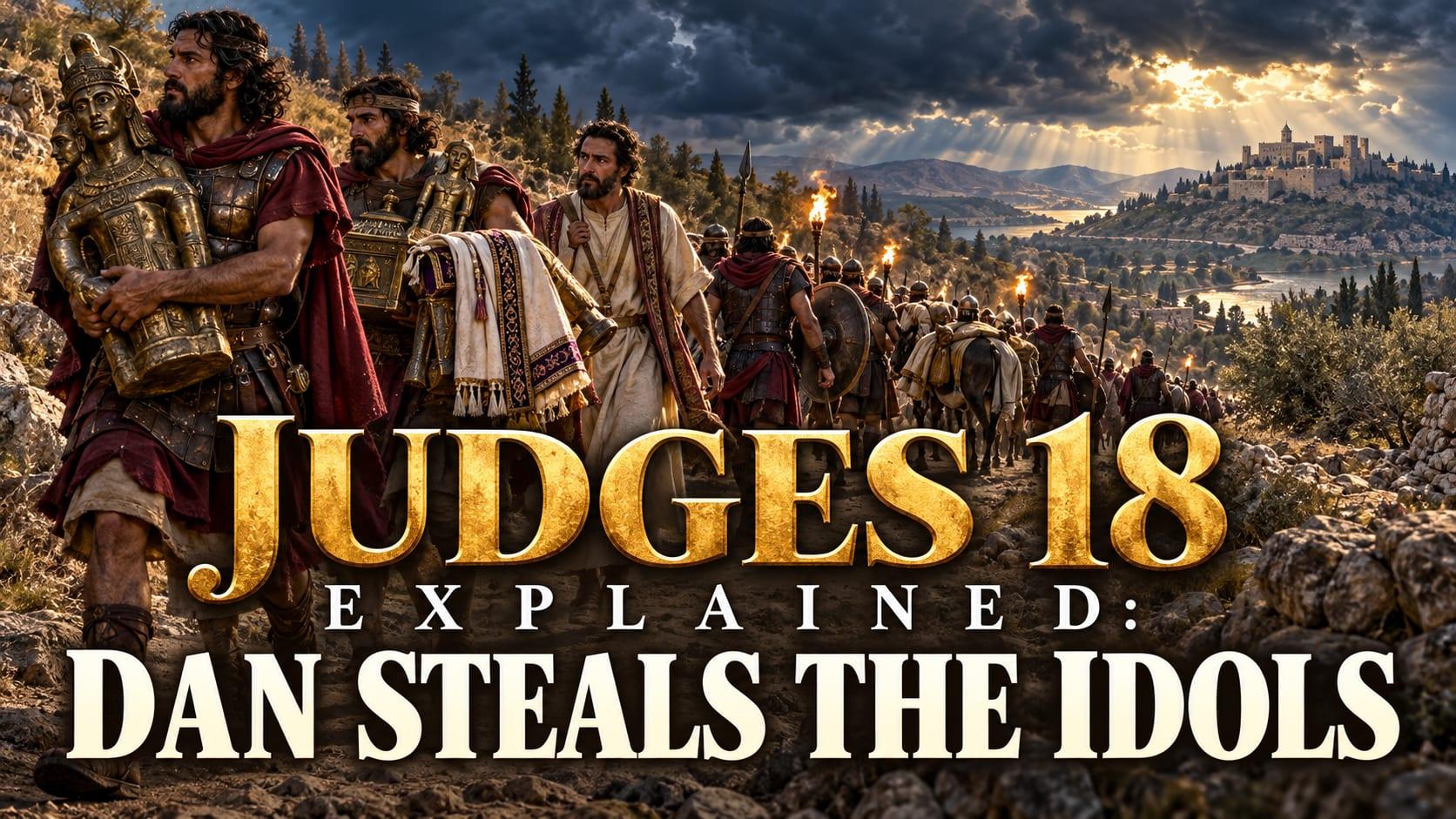
📖 Judges 18 Explained: A Tribe Steals a Priest and a God
Five spies walk into Micah's house looking for land.
Six hundred soldiers walk out of it with his gods, his priest, and his son's blessing.
Judges 18 explained is the sequel to the private religion built in the previous chapter, and it shows exactly how little that religion was worth defending once an entire tribe wanted it for itself. The whole tribe of Dan is still without a permanent home late in the book of Judges, and this chapter follows them as they go looking for one, pick up Micah's idols along the way almost as an afterthought, and burn a defenseless city to make room for themselves.
Maybe you have watched something built on a shaky foundation get taken over by whoever showed up with more force.
- ❓ Why was the tribe of Dan still searching for land this late in Israel's history?
- ❓ What did it mean to "ask counsel of God" through Micah's priest?
- ❓ Why did the Levite switch sides the moment a bigger offer came along?
- ❓ Did God actually give the Danites the city of Laish, or did they only assume He did?
📌 Judges 18 is the chapter where convenience gets mistaken for God's approval, from a lazy answer at a private shrine all the way to a city burned to the ground.
This walkthrough covers the whole chapter in order: the spies who stumble onto Micah's Levite, the quick blessing he hands them, the unguarded city of Laish, the six hundred armed men who go back for the idols, the priest who switches loyalties without a second thought, Micah's hollow protest, and the new city of Dan that keeps worshipping a stolen idol for generations.
Nobody in this chapter asks whether what they are doing is right. Everyone only asks whether it will work.
What Happened Just Before This Chapter
Judges 17 ended with Micah fully satisfied with the religion he had built in his own house, a graven image, a molten image, an ephod, teraphim, and finally a genuine Levite hired as his personal priest. He closed the chapter certain the LORD would now bless him, simply because the staff running his shrine finally looked official.
Judges 18 explained does not open with Micah at all. It opens with a tribe that has been without its full inheritance since the earliest chapters of this book. Dan had already been pushed back once before, and that old, unfinished problem is exactly what drives everything that happens in this chapter.

Judges 18 Explained Verse by Verse
1. A Tribe Still Without Land (verses 1 and 2)
The chapter opens by naming the same lawless era as the chapter before it, then introduces a whole tribe with the same problem Micah had on a smaller scale.
"In those days there was no king in Israel: and in those days the tribe of the Danites sought them an inheritance to dwell in; for unto that day all their inheritance had not fallen unto them among the tribes of Israel."
💡 Dan's territory had already been assigned, laid out in detail in Joshua 19. The problem was never the assignment. It was that Dan never finished taking it. Early in this same book, Judges 1 records that the Amorites forced the children of Dan back into the hill country and would not let them come down into the valley. Generations later, the tribe is still squeezed into land too small for them.
📌 This is not a tribe chasing a new conquest for the thrill of it. Dan is dealing with a problem their own ancestors left unfinished, and this chapter shows how they finally chose to solve it.
"And the children of Dan sent of their family five men from their coasts, men of valour, from Zorah, and from Eshtaol, to spy out the land, and to search it; and they said unto them, Go, search the land: who when they came to mount Ephraim, to the house of Micah, they lodged there."
Zorah and Eshtaol were Danite towns, familiar from the opening of Judges 13, where Samson was born into the same tribe. Five capable men set out to scout new territory, and by chance, or by the narrator's design, their road runs directly through Micah's house in mount Ephraim.
2. A Convenient Word From a Borrowed Priest (verses 3 to 6)
The spies recognize something in the house that a stranger would never notice.
"When they were by the house of Micah, they knew the voice of the young man the Levite: and they turned in thither, and said unto him, Who brought thee hither? and what makest thou in this place? and what hast thou here?"
💡 Levites were scattered across the tribes and would have had a distinct accent or manner of speech that marked them out. These five men from Zorah instantly recognize a Levite's voice, which tells you how unusual it was for one to be living inside a private house instead of serving at the tabernacle.
Once he explains his arrangement with Micah, the spies make a request of their own.
"And they said unto him, Ask counsel, we pray thee, of God, that we may know whether our way which we go shall be prosperous. And the priest said unto them, Go in peace: before the LORD is your way wherein ye go."
⚠️ Notice what is actually being consulted here. This is not the Urim and Thummim carried by Israel's high priest at the tabernacle. It is whatever Micah's ephod and teraphim offered inside an unauthorized house shrine, run by a man who had been hired for a yearly wage. The answer costs the priest nothing and risks nothing. He simply tells five armed strangers exactly what they came hoping to hear.
📌 A quick yes is not the same thing as God's word. The text never shows God speaking at all in this exchange. It only shows a hired man speaking on His behalf.

3. Laish, Quiet and Unguarded (verses 7 to 10)
The five spies press on north and find exactly what Dan needed.
"Then the five men departed, and came to Laish, and saw the people that were therein, how they dwelt careless, after the manner of the Zidonians, quiet and secure; and there was no magistrate in the land, that might put them to shame in any thing; and they were far from the Zidonians, and had no business with any man."
💡 Laish sat in the far north of the land, well beyond the reach of its nearest large neighbor, Zidon. That distance left it peaceful, prosperous, and completely unprepared for an attack, exactly the kind of target five scouts would be thrilled to report back about.
Their report to the rest of the tribe is blunt and urgent.
"And they said, Arise, that we may go up against them: for we have seen the land, and, behold, it is very good: and are ye still? be not slothful to go, and to enter to possess the land."
"When ye go, ye shall come unto a people secure, and to a large land: for God hath given it into your hands; a place where there is no want of any thing that is in the earth."
⚠️ Read that last line carefully. It is the spies declaring that God has given them the land, not a word from God recorded anywhere in the chapter saying so. The only confirmation they actually received was a hired priest's convenient "go in peace" back at Micah's house. By the time the report reaches the rest of the tribe, that thin confirmation has hardened into certainty.
4. Six Hundred Men Go Back for the Gods (verses 11 to 20)
Dan does not send a small raiding party. An armed force moves out in strength.
"And there went from thence of the family of the Danites, out of Zorah and out of Eshtaol, six hundred men appointed with weapons of war."
On their way north, the same five spies steer the whole column back through mount Ephraim, straight to Micah's house, and remind their brothers exactly what sits inside it.
"Then answered the five men that went to spy out the country of Laish, and said unto their brethren, Do ye know that there is in these houses an ephod, and teraphim, and a graven image, and a molten image? now therefore consider what ye have to do."
📌 Once Dan has the manpower to take whatever it wants, Micah's private religion stops being his and becomes a resource for someone stronger. The six hundred stand guard at the gate while the five original spies walk in and simply take the graven image, the ephod, the teraphim, and the molten image.
The Levite tries to object, and the response he gets settles the matter instantly.
"And these went into Micah's house, and fetched the carved image, the ephod, and the teraphim, and the molten image. Then said the priest unto them, What do ye? And they said unto him, Hold thy peace, lay thine hand upon thy mouth, and go with us, and be to us a father and a priest: is it better for thee to be a priest unto the house of one man, or that thou be a priest unto a tribe and a family in Israel?"
💡 The offer is a straightforward upgrade: trade one household's wage for an entire tribe's support. It is the same kind of calculation that got this Levite hired by Micah in the first place, just repeated on a bigger scale.
"And the priest's heart was glad, and he took the ephod, and the teraphim, and the graven image, and went in the midst of the people."
📌 Not reluctant. Not torn. Glad. The man set apart to serve God walks off with stolen idols toward a stolen city, and the chapter records no hesitation in him at all.

5. Micah's Protest Goes Nowhere (verses 21 to 26)
Micah finds out what happened and does the only thing left to him.
"And when they were a good way from the house of Micah, the men that were in the houses near to Micah's house were gathered together, and overtook the children of Dan."
"And he said, Ye have taken away my gods which I made, and the priest, and ye are gone away: and what have I more? and what is this that ye say unto me, What aileth thee?"
⚠️ Micah calls them "my gods which I made." He says it without apparently noticing the problem in his own sentence. A god that a man makes with his own hands is not in a position to defend him from anyone, which is exactly what Micah is about to find out.
Dan's answer is a threat, plain and unembarrassed.
"And the children of Dan said unto him, Let not thy voice be heard among us, lest angry fellows run upon thee, and thou lose thy life, with the lives of thy household."
📌 Micah gathered his neighbors to confront six hundred armed men, and the math was never close. Verse 26 says he simply turned and went home once he saw they were too strong for him. The gods he built could not save themselves, and neither could he.
6. Laish Burns, and a New City Called Dan Keeps the Idol (verses 27 to 31)
The chapter's final movement is fast and brutal.
"And they took the things which Micah had made, and the priest which he had, and came unto Laish, unto a people that were at quiet and secure: and they smote them with the edge of the sword, and burnt the city with fire."
"And there was no deliverer, because it was far from Zidon, and they had no business with any man; and it was in the valley that lieth by Bethrehob. And they built a city, and dwelt therein."
💡 The very isolation that made Laish a safe, peaceful place to live, far from Zidon's help, with no treaty binding anyone to defend it, is the same isolation that left it with no one to rescue it. Dan renames the rebuilt city after their own tribal father and settles in for good.
The chapter's last two verses settle the idol into permanent use.
"And the children of Dan set up the graven image: and Jonathan, the son of Gershom, the son of Manasseh, he and his sons were priests to the tribe of Dan until the day of the captivity of the land."
⚠️ Many Hebrew manuscripts carry a well known scribal mark over the name "Manasseh" here. Jewish and Christian textual scholars have long noted that the letter forming "Manasseh" appears to be a later insertion over an earlier reading of "Moses." If that older reading is correct, this priestly line descends from Moses himself, and a scribe may have adjusted it rather than let Moses' own name sit next to a stolen idol. Scholars continue to debate it, and the KJV text you can read for yourself preserves "Manasseh."
📌 Whichever reading is original, the point of the verse does not change. A stolen idol from one man's private house became a tribe's official worship for generations, run by a line of priests, lasting all the way until Israel's later captivity.
"And they set them up Micah's graven image, which he made, all the time that the house of God was in Shiloh."
The chapter ends by pointing out, almost in passing, that Dan's stolen idol stood the entire time Israel's legitimate place of worship, the tabernacle at Shiloh, was still functioning. The counterfeit and the real thing operated at the same time, and nothing in this chapter shows anyone stepping in to stop either one.

Hard Questions Judges 18 Raises
Did God really tell the Danites that Laish was theirs? What the text says: verse 10 records the five spies telling their brothers "God hath given it into your hands," but no verse in the chapter shows God saying this to anyone. How this is read: their confidence traces back only to a hired priest's quick "go in peace" in verse 6, not to a word from God through any authorized means. The honest answer is that the chapter records human certainty, not divine confirmation.
Was consulting Micah's priest a legitimate way to seek God's will? What the text says: the spies ask the Levite to "ask counsel of God," and he answers immediately through whatever means Micah's unauthorized ephod and teraphim provided. How this is read: this stands in sharp contrast to the Urim and Thummim used by Israel's legitimate high priest. The chapter does not comment on the difference directly, but it has already told you in Judges 17 exactly what kind of shrine this priest served.
Was Jonathan the priest descended from Moses or from Manasseh? What the text says: the KJV reads "the son of Gershom, the son of Manasseh." How this is read: a long recognized scribal mark in the Hebrew manuscripts over this name has led many textual scholars to conclude the earlier reading was "Moses," later adjusted in transmission. Both views are held by serious scholars, and Scripture itself does not resolve which reading came first.
Why did the Levite switch loyalty so easily? What the text says: he raises one brief objection, "What do ye?" in verse 18, then goes gladly once offered a tribe's support instead of one household's wage. How this is read: the text gives his choice, not an inner confession of motive. It lets the speed of his turnaround speak for itself, the same way it did with his willingness to take Micah's job in the first place.
Top Verses From Judges 18
1. Judges 18:1
"In those days there was no king in Israel: and in those days the tribe of the Danites sought them an inheritance to dwell in; for unto that day all their inheritance had not fallen unto them among the tribes of Israel."
A whole tribe still carrying an old, unfinished problem generations after their land was first assigned, which sets in motion everything else in the chapter.
2. Judges 18:6
"And the priest said unto them, Go in peace: before the LORD is your way wherein ye go."
A quick, costless answer from a hired priest that an entire tribe later treats as settled divine approval for a conquest God never actually spoke about.
3. Judges 18:19
"Is it better for thee to be a priest unto the house of one man, or that thou be a priest unto a tribe and a family in Israel?"
The offer that ends the Levite's loyalty to Micah in a single sentence, trading one household's wage for a whole tribe's support without a second thought.
4. Judges 18:24
"And he said, Ye have taken away my gods which I made, and the priest, and ye are gone away: and what have I more?"
Micah calling idols he built with his own hands "my gods," right before learning firsthand that gods a man makes cannot defend the man who made them.
5. Judges 18:31
"And they set them up Micah's graven image, which he made, all the time that the house of God was in Shiloh."
A stolen idol operating as official worship for generations, running at the very same time Israel's legitimate tabernacle stood at Shiloh.
Frequently Asked Questions About Judges 18
What happened in Judges 18?
The tribe of Dan, still without enough land, sent five spies north who stopped at Micah's house and got a favorable word from his hired Levite priest. They found the peaceful, unguarded city of Laish, then returned with six hundred armed men who took Micah's idols and his priest along the way. Dan destroyed Laish, rebuilt it as their own city named Dan, and kept Micah's stolen idol as their official worship for generations.
Why did the tribe of Dan still need land this late in Judges?
Dan's territory had been assigned back in Joshua 19, but Judges 1:34 records that the Amorites forced them into the hill country and kept them from the valley land they were given. Generations later, this chapter shows them finally solving that old problem by taking a new city far to the north instead.
Where was Laish, and who lived there?
Laish sat in the far north of the land, well beyond the reach of its nearest large neighbor, Zidon. Verse 7 describes its people living careless, quiet, and secure, with no magistrate and no outside alliance, which left them completely unprepared when Dan attacked.
Did God actually tell the Danites to take Laish?
The chapter never records God saying this directly. The spies declare in verse 10 that God has given them the land, but that claim rests on a quick, costless answer from Micah's hired priest rather than any confirmed word from God through legitimate means.
Was Jonathan the priest really the grandson of Moses?
The KJV text names him "the son of Gershom, the son of Manasseh." A long recognized scribal mark over that name in Hebrew manuscripts has led many textual scholars to think the earlier reading was "Moses," later adjusted in copying. Scholars still hold different views, and both readings are taken seriously.
Why did the Levite agree to switch from Micah to the tribe of Dan?
Verse 19 shows Dan offering him the chance to be priest to an entire tribe instead of one household, and verse 20 says his heart was glad to take the offer. The same willingness to serve whoever paid best that brought him to Micah's house in Judges 17 moves him again here.
What happened to Micah after the Danites left?
Micah gathered his neighbors and pursued Dan, but verse 26 says he turned back home once he saw they were too strong for him. The chapter never mentions him again after that, leaving him with neither his gods nor his priest.
Why did Dan burn Laish instead of settling peacefully?
Verse 27 simply records that they smote the city with the edge of the sword and burnt it, without giving a reason beyond their earlier scouting report that the land was good and the people were unprepared to resist.
How long did Dan keep worshipping Micah's stolen idol?
Verse 30 says the priestly line descended from this chapter's priest served the tribe of Dan "until the day of the captivity of the land," meaning this counterfeit worship system lasted for generations, long after the events of this one chapter were finished.
How does Judges 18 connect to Judges 17?
Judges 17 built the private shrine, the idols, and the hired priest that this chapter takes by force. Everything Micah assembled piece by piece becomes the very thing an entire tribe decides it wants for itself, proving how little protection his homemade religion actually offered.
Final Thoughts
Judges 18 moves fast, but it leaves a slow, uncomfortable question behind it.
📌 A convenient answer is not the same thing as God's will. The Danites built an entire conquest on a hired priest's costless "go in peace," never once hearing from God directly, and never seeming to need to.
📌 Gods you build cannot defend you when someone stronger comes for them. Micah called his idols "my gods which I made," and the moment they were truly tested, neither the idols nor the man who made them could stand against six hundred armed men.
You are probably not deciding whether to burn a city this week. But you may be trusting an answer because it was easy to get, rather than because you actually sought God for it.
So here is your one next step.
Before you call a decision settled, ask whether you have actually heard from God about it, or whether, like the Danites, you only heard what you were hoping someone would tell you.